
Consider the scale of the problem. According to Signicat's 2022 survey of 7,600 consumers across 14 European markets, 68% of applicants abandoned financial services onboarding—up from 63% in 2020. Each abandoned prospect represents up to $45,600 in lost lifetime value, and European banks collectively waste £5.47 billion annually on customer acquisition costs tied to failed onboarding.
AI-powered onboarding automation isn't just about speed—it's about orchestrating identity verification, document intelligence, fraud detection, and workflow automation into a seamless, compliant experience that converts. This article explores how modern FinTechs leverage AI to transform onboarding from a competitive liability into a strategic advantage.
TLDR:
- FinTech onboarding abandonment rates reach 68%, costing banks billions in lost customer lifetime value
- Manual KYC processes take 26 days on average and cost $1,500-$3,000 per review
- AI automation reduces verification costs by 70% and cuts processing time by 78%
- Intelligent document processing eliminates manual data entry using NLP and OCR
- Human-in-the-loop design maintains compliance while automating routine decisions
Why Traditional Onboarding Is a Competitive Liability for FinTechs and Neo Banks
Legacy Workflows Built for Branches, Not Digital Customers
Legacy onboarding processes were designed for branch banking, not digital-first customers. They rely on manual data entry across siloed systems and fragmented handoffs between sales, operations, and compliance teams. Verification checks run in isolation rather than in real time.
The pattern is consistent across institutions: lengthy forms, document upload delays, and multi-day verification waiting periods — each one compounding dropout probability at every step.
The Compliance Friction Trap
KYC, AML, and KYB requirements mean FinTechs must collect more sensitive data than almost any other digital service. Manual review of that data creates delays that erode trust before accounts are even opened.
The timeline problem:
- Thomson Reuters' 2017 Global KYC Survey found the average client onboarding time was 26 days
- Fenergo's 2025 KYC Trends Report shows banks spend $1,500-$3,000 per manual KYC review
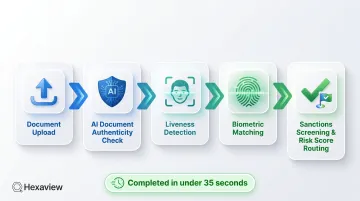
- Manual processing takes 18+ minutes per customer, while automated systems complete verification in under 35 seconds
The Neo Bank-Specific Disadvantage
That compliance friction hits Neo Banks hardest. Neo Banks compete on UX and speed against incumbents with decades of brand trust — yet many still run onboarding processes that mirror the paper-heavy workflows they were supposed to replace.
The stakes are asymmetric:
- Traditional banks can absorb a slow onboarding experience — customers return because of brand familiarity
- Neo Banks have one shot: the first 60 seconds, where multi-day document delays turn prospects into churned leads before an account is ever opened
The Hidden Compliance Cost
Manual verification is also error-prone and expensive. Fenergo's 2023 Global Enforcement Actions Report found global AML fines reached $6.6 billion in 2023, a 57% increase year-over-year. According to Markaaz research, 60% of fintech firms paid at least $250,000 in compliance fines in a single year.
The cost breakdown:
- Average firm spends $72.9 million annually on AML and KYC operations
- 54% of banks spend $1,500-$3,000 per manual review
- 21% spend over $3,000 per client
- Poor KYC controls were involved in 70% of enforcement actions against U.S. banks in the past five years

The AI Technologies Driving Modern Onboarding Automation
AI-Powered Identity Verification
Machine learning models go beyond static document checks to perform liveness detection, biometric matching, and real-time fraud signal analysis. Unlike rule-based legacy systems that check documents against predefined templates, AI models learn from millions of verification attempts to detect sophisticated forgeries.
Entrust's 2025 Identity Fraud Report analyzed tens of millions of identity verifications across 195 countries and found:
- 1 in 4 identity verification attempts is now a deepfake attempt
- 244% increase in digital document forgeries over the past year
- 153% increase in cryptocurrency-related identity fraud
AI-powered liveness detection counters these threats by analyzing micro-movements, depth perception, and behavioral patterns that synthetic media cannot replicate.
Intelligent Document Processing (IDP)
NLP and OCR-based AI extract, validate, and pre-fill data from uploaded IDs, proof of address, and business registration documents in seconds, eliminating manual review queues.
IDP systems combine:
- Optical character recognition to extract text from images
- Natural language processing to understand context and validate consistency
- Machine learning models that improve accuracy over time
- Real-time validation against government databases and watchlists
The result: applicants photograph their ID, and within seconds, their personal information populates the application form with accuracy exceeding manual data entry.
AI-Driven Risk Scoring
ML models assess applicant risk in real time by cross-referencing sanctions watchlists, PEP databases, adverse media, and behavioral signals. This enables automated pass/review/reject routing rather than blanket human review.
How risk scoring works:
- Data aggregation — The system pulls identity data, device fingerprints, behavioral signals, and external database records into a unified applicant profile
- ML models then compare that profile against known fraud patterns and compliance red flags, weighing hundreds of signals simultaneously
- The applicant receives a risk score that determines routing: auto-approve (low risk), human review (medium risk), or reject (high risk)
- Continuous learning — Models update based on real outcomes, so accuracy improves as the system processes more decisions
Conversational AI and Intelligent Notifications
AI chatbots handle 24/7 applicant queries about document requirements, status updates, and re-submission guidance. Predictive models flag at-risk applicants before they abandon, enabling proactive intervention.
When an applicant pauses mid-application for 90 seconds, the system can trigger a contextual help prompt. If documents are rejected, automated notifications explain exactly what's needed rather than generic error messages.
Rule-Based vs. True AI
Each technology described above fits somewhere on a spectrum from rule-based to genuinely adaptive AI — and knowing the difference helps avoid over-engineering simple tasks or under-investing in complex ones.
Rule-based RPA executes predefined workflows reliably: routing forms, firing email triggers, moving data between systems. It doesn't learn or adapt, but it doesn't need to for structured, repeatable tasks. AI adds judgment — adjusting decisions based on patterns, context, and evolving data — which is why it handles fraud detection and risk scoring better than any fixed ruleset can.
The practical approach combines both: RPA for structured operations where consistency matters, AI for the judgment calls where context does.
High-Impact Use Cases: Where AI Transforms FinTech Onboarding
Automated KYC and KYB Verification
Individual Identity (KYC)
Automated KYC verifies individual identity end-to-end: document authenticity checks, facial liveness matching, sanctions/watchlist screening, and risk scoring—all within minutes rather than days.
AU10TIX research found automated KYC:
- Reduces processing costs by up to 70%
- Cuts verification time by 78%
- Enhances fraud detection accuracy by 61% compared to manual review
The workflow: applicant uploads government ID and takes selfie → AI validates document authenticity → liveness detection confirms real person → biometric matching verifies ID photo matches selfie → sanctions screening runs automatically → risk score determines routing.
Business Accounts (KYB)
AI verifies legal entity existence, beneficial ownership structures, and corporate risk profiles by querying business registries and cross-referencing structured data—critical for Neo Banks serving SME clients.
GBG's Know Your Business platform accesses 600M+ company records and ownership registries to:
- Reduce end-to-end onboarding times by up to 60%
- Cut manual customer checks by an average of 38%
- Verify beneficial ownership automatically across multiple jurisdictions
Progressive Disclosure and Smart UX Automation
Instead of front-loading all data collection, the system asks only what's needed at each stage and adjusts the journey in real time based on risk profile. High-risk applicants are routed to enhanced verification while low-risk users are fast-tracked.
How it works in practice:
- Low-risk applicant (strong digital footprint, domestic address, standard income) → 3-minute flow with minimal documentation
- Medium-risk applicant (new to country, self-employed income) → additional proof of address and income verification
- High-risk applicant (PEP status, high-risk jurisdiction) → enhanced due diligence with manual review
Embedded inline verification—real-time document OCR, instant field pre-fill, live validation feedback—keeps users moving through the flow and reduces the confusion that causes drop-off.
Intelligent Workflow Orchestration
Optimizing individual tasks only goes so far. The largest efficiency gains come from orchestrating the entire onboarding journey end-to-end—routing tasks to the right person at the right time with full context, and eliminating the email silos and approval delays that stall sales, compliance, and operations teams.
Orchestration components:
- Automated task assignment based on workload, expertise, and priority
- Context-rich notifications that include applicant history and risk factors
- Escalation logic that routes edge cases to senior reviewers
- Real-time status dashboards showing bottlenecks and completion rates
eSignature Automation
Once orchestration routes the applicant through compliance and review, digital agreement signing is typically the final handoff point—and historically, a slow one. Embedding eSignatures directly into the onboarding flow eliminates that delay. DocuSign research found:
- Up to 80% of agreements completed in less than a day
- 44% of agreements completed in under 15 minutes
- Average contract turnaround 15 days faster than manual processes
- FineMark National Bank reduced 12-hour onboarding to "the click of a button," processing 200-300 accounts per month
Building an AI-Powered Onboarding Flow: A Step-by-Step Roadmap
Step 1 — Audit and Map
Map the current onboarding journey in full before automating. Identify where handoffs occur, where data is re-entered manually, and where compliance checks create bottlenecks.
Automating a flawed process just accelerates the flaws. Before touching a single workflow, answer these questions:
- How many systems touch applicant data during onboarding?
- Where does data get manually re-entered between systems?
- Which compliance checks run sequentially vs. in parallel?
- What percentage of applications require manual intervention, and why?
- At which step do most applicants abandon?
Step 2 — Integrate Data and Identity Infrastructure
Connect your CRM, KYC/KYB vendor APIs, document management systems, and banking core systems into a unified data layer. This gives AI models clean, real-time inputs — and eliminates manual data re-entry between systems.
Integration requirements:
- Real-time API connections to identity verification providers
- Bidirectional sync between CRM and core banking systems
- Document storage with OCR-extracted metadata
- Sanctions and watchlist database access
- Audit logging for regulatory compliance
Step 3 — Layer AI Progressively and Maintain Human Oversight
AI should handle routine verifications and routing while compliance teams retain decision authority on flagged or high-risk cases. This "human-in-the-loop" model is both a regulatory requirement and a trust-building mechanism.
Regulatory frameworks back this approach. FATF's Guidance on Digital Identity supports digital IDs using high-assurance components and recommends a tiered model — straight-through processing for low-risk customers, human review for high-risk alerts — where assurance level matches the risk profile of each transaction.
Oversight framework:
- Define clear thresholds: below X risk score = auto-approve, X-Y = human review, above Y = reject
- Build compliance dashboards showing auto-approval rates and review queue status
- Implement audit trails capturing all AI decisions and human overrides
- Regular model validation to prevent bias and ensure effectiveness
What AI Onboarding Automation Actually Delivers: Metrics That Matter
Conversion and Speed Outcomes
The speed gains are measurable and consistent across sources:
- FNZ research found automation cuts overall onboarding time by up to 90% — manual KYC takes 18+ minutes per customer; automated eKYC completes in 35 seconds or less
- AppstekCorp reports an 80-90% reduction in onboarding time for standard-tier customers when agentic KYC is deployed
Compliance and Cost Outcomes
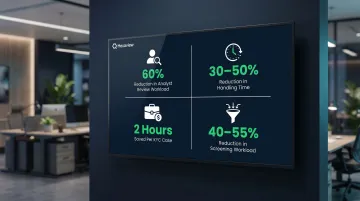
KPMG research shows up to 85% of KYC effort is clerical work rather than risk judgment—automatable tasks. Automation delivers:
- Approximately 60% reduction in analyst review workload
- 30-50% reduction in handling time for high-volume banks
- Average of 2 hours saved per case
- 40-55% reduction in screening workload and alert resolution
Cost-per-verified-account drops sharply when manual processing costs ($1,500–$3,000 per account) give way to automated systems handling routine verifications at scale.
Customer Trust and Retention Outcomes
Onboarding experience directly shapes revenue and retention — not just first impressions:
- McKinsey research found every one-point increase in onboarding NPS correlates with a 3% increase in customer revenue
- Signicat's 2020 survey found more than 50% of customers are less inclined to use a bank again after a poor onboarding experience