Introduction
Financial services firms are sitting on vast reserves of valuable data—yet fragmented systems, manual workflows, and legacy infrastructure prevent most from converting that data into competitive intelligence. According to Harvard Business Review, less than half of an organization's structured data is actively used in making decisions, and less than 1% of unstructured data is analyzed at all. Meanwhile, 80% of analysts' time is spent discovering and preparing data rather than extracting insights.
That investment is driving a fundamental shift in how firms operate. Data management and AI automation have become the primary levers for revenue growth, regulatory compliance, and client experience in financial services. This piece covers five key trends reshaping how FinTech and wealth management firms architect their data infrastructure, automate operations, and deliver personalized advice at scale — from AI-driven data governance to real-time analytics and agentic automation.
Key Takeaways
- AI automates document processing and validation, reducing errors and freeing analysts for strategic work
- Cloud-native architectures deliver self-serve analytics, cutting IT bottlenecks and dependency on technical teams
- Real-time client data platforms power tailored experiences that today's investors increasingly demand
- Compliance automation handles escalating regulatory demands without expanding headcount
- API-first platforms connect front- and back-office systems, replacing fragmented data with a single source of truth
Trend 1: AI-Driven Data Automation and Intelligent Document Processing
Financial institutions are applying AI and machine learning to automate extraction, classification, and validation of financial data—trade confirmations, KYC files, account statements, regulatory filings—work that has historically been manual, slow, and error-prone. The shift is now reaching production scale.
Real-World Adoption Accelerating
BNY's Data & Analytics platform demonstrates this shift in production. Julie Gerdeman, managing director at BNY, explains: "In our data platform AI is driving efficiencies in the onboarding, governance, and migration of high-quality data." The cloud-native SaaS platform serves 200+ global clients with 200+ external data integrations, using AI-enabled architecture to normalize both structured and unstructured data.
74% of financial services firms are now investing in AI and GenAI, with 84% reporting measurable ROI. These aren't pilot programs — they're live systems running in production.
Measurable Productivity Gains
McKinsey research from December 2024 documents specific improvements:
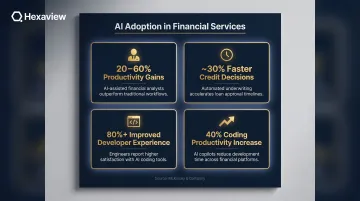
- 20-60% productivity gains for credit analysts using multiagent AI systems
- Approximately 30% faster decision-making in credit underwriting
- More than 80% of developers reported improved coding experience with GenAI
- 40% increase in coding productivity at a regional bank
Tim Lind, managing director at DTCC Data Services, puts it plainly: "AI is going to bring scale and precision to capturing data from documents"—processes currently manual and error-prone. That precision compounds downstream.
Downstream Benefits Beyond Speed
Faster data entry is only part of the value. AI-driven document processing also delivers:
- Catches inconsistencies that manual review misses, reducing downstream errors
- Flags unusual patterns in real time, strengthening fraud prevention and risk controls
- Compresses processing from hours to minutes without adding headcount
- Generates complete data lineage logs that satisfy regulatory audit requirements
Production-Grade Implementation Matters
Deploying AI in financial services requires more than working models — it requires systems that hold up under compliance scrutiny. Hexaview Technologies, recognized in the WealthTech 100 and DATATECH50, works with Fortune 100 capital markets clients to build AI engineering solutions designed for this environment: where regulatory requirements shift frequently and data errors carry real financial and legal consequences.
Trend 2: Cloud-Native Infrastructure and Democratized Self-Serve Analytics
Financial firms are migrating from siloed on-premise databases to cloud-native data ecosystems that centralize positions, transactions, and reference data. The result: real-time discovery and self-service analytics accessible to business users, not just data engineers. The result: real-time discovery and self-service analytics accessible to business users, not just data engineers. Three dynamics are driving this shift — how firms migrate, why normalization matters, and what the business impact looks like in practice.
From Technical Silos to Democratized Access
Cboe Global Markets' migration to Snowflake illustrates this transformation. Eileen Smith, SVP of Data and Analytics at Cboe, explained the before and after:
Before: Siloed databases requiring technical skills and delivering raw data dumps
After: Democratized, self-serve environment with bespoke data streams for each business line consolidating actionable information
Smith's team established an AI Center of Excellence to ensure responsible tool usage, emphasizing that "a data strategy should never be finished—we're constantly evolving as new use cases and capabilities emerge."
Why Normalization Enables Intelligence
Cloud infrastructure doesn't just improve storage: it enables the AI layers sitting on top to function intelligently. Data normalization within cloud ecosystems is the critical precursor that shifts focus from data engineering mechanics to data intelligence.
Tim Lind at DTCC explains: "Cloud and AI will mask the underlying complexity of data, shifting the focus to data intelligence rather than the mechanics of data engineering."
Measurable Business Impact
Cloud migration delivers measurable outcomes:
- Cost reduction: Financial services firms could reduce infrastructure costs by up to 30% through cloud migration, per a McKinsey estimate cited by The Wealth Mosaic
- Faster insights: Elimination of data bottlenecks and reduced dependency on IT for reporting
- Scalability: Infrastructure that supports growing alternative asset classes and private markets data
- Alternative data integration: Cloud-native platforms handle unstructured data from non-traditional sources
For wealth managers and capital markets firms specifically, this shift means analysts can run queries, build reports, and surface insights without waiting on engineering queues — compressing the time from data to decision from days to hours.
Trend 3: Real-Time Client Data Management and Hyper-Personalization in Wealth Management
Wealth management is shifting from periodic, batch-based client reporting to continuous, real-time client data management. Firms integrate behavioral data, portfolio performance, life events, and market signals to deliver personalized financial guidance and proactive alerts.
The Urgency: $83.5 Trillion at Risk
Capgemini's World Wealth Report 2025 reveals a striking disconnect:
- 81% of Next-gen HNWIs plan to switch their parent's wealth management firm within 1-2 years of inheritance
- 46% cite lack of digital channels as the primary reason
- 71% of wealth management executives acknowledge Next-gen clients prefer digital-first engagement
- Yet only 29% of firms have developed tailored offerings for this segment
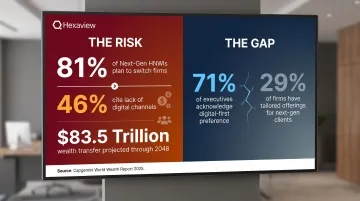
The total wealth transfer through 2048: $83.5 trillion. Firms that fail to modernize client data platforms risk losing the largest generational wealth transfer in history.
What Real-Time Client Data Platforms Enable
Cross-function integration platforms unify:
- CRM data and relationship history
- Transaction records and portfolio performance
- Risk tolerance profiles and investment preferences
- Behavioral data and life event triggers
- Market signals and personalized alerts
One wealth manager implementing the fincite integrated client data platform achieved 3x growth in Assets Under View, a 20% increase in wallet share, and an 83% cut in operational costs, according to Capgemini's research.
Market Growth Reflects Demand
The digital wealth management market was valued at $10.2 billion in 2025 and is projected to reach $38.6 billion by 2034, growing at a ~16% CAGR. Clients now expect the same personalization from their wealth managers that they get from everyday consumer apps — and most firms aren't delivering it.
The data makes the shortfall concrete:
- 47% of relationship managers are dissatisfied with their firm's digital tools
- 56% of firms lack omnichannel or self-service platforms
For firms still relying on legacy client data systems, this gap doesn't just affect satisfaction scores — it hands the next generation of clients to competitors who built for them first.
Trend 4: Automated Data Governance, Compliance Automation, and Cyber Resilience
Regulators demand more granular, traceable, and frequently collected financial data. Firms are automating compliance reporting, data lineage tracking, and governance frameworks rather than scaling headcount.
The Dual Imperative: Offense and Defense
Harvard Business Review's 2017 framework on data strategy introduced the offense/defense balance:
- Defense: Compliance, security, privacy, data quality—requiring a Single Source of Truth
- Offense: Revenue, customer insights, analytics—leveraging Multiple Versions of the Truth
The framework argues companies cannot maximize both simultaneously and must make strategic trade-offs. A financial services company that consolidated 130 data sources into one SSOT achieved a 190% return on investment with a two-year payback period.
Escalating Regulatory Requirements
Recent regulatory changes intensify data governance demands:
- SEC T+1 Settlement (May 2024): Shortened settlement cycles require near-real-time data accuracy and faster processing
- FCA CP25/32 (November 2025): Proposed UK transaction reporting reforms increase granularity and quality requirements
- 84% of financial organizations are implementing or planning AI governance frameworks, according to WEF's 2025 report
Cyber Resilience Inseparable from Data Governance
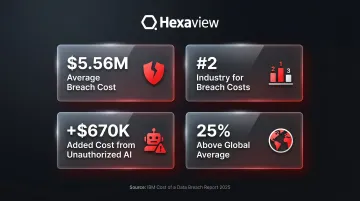
IBM's Cost of a Data Breach Report 2025 found:
- Financial services breaches average $5.56 million, which is 25% above the global average
- Financial services ranks #2 in breach costs (behind only healthcare)
- Organizations with high unauthorized AI use face an added $670,000 per breach
- Financial services had the highest representation among breached organizations studied
These numbers have shifted board-level conversations. Data health is no longer just a technology concern — it's a fiduciary one. Hexaview Technologies' SOC 2 Type 2 certification reflects this reality: financial firms increasingly require technology partners who can demonstrate verifiable security controls, not just claim them.
Trend 5: API-First Architecture and the Dismantling of Data Silos
Open APIs and integrated platform architectures let financial data move freely between core systems—trading platforms, CRMs, custodians, and analytics tools. The result is a shift away from fragmented point-to-point integrations toward unified data pipelines that actually scale.
The Cost of Data Silos
Tim Lind at DTCC identifies the core challenge: "The primary challenges institutions are facing stem from siloed systems across functions and asset classes." These disconnected platforms—often mixing on-premise and cloud—"hinder firms from realizing the full potential of their data."
Julie Gerdeman at BNY puts the scale in focus: "Nearly 40% of investment managers are undertaking significant operating model transformations—with data at the center—to get to this next stage of data maturity."
What API-First Architecture Delivers
Pre-built connectors, standardized data exchange protocols, and cloud-native integrations allow business users to access consolidated data without bespoke engineering work.
Key capabilities include:
- Standardized protocols: REST APIs and web services enabling interoperability
- Pre-built integrations: 200+ external data connections in platforms like BNY's Data & Analytics
- Secure data sharing: Distribution channels creating data monetization opportunities
- Multi-system orchestration: Unified pipelines coordinating disparate systems without custom point-to-point builds
BNY's platform features "flexible, open architecture" designed for multi-currency, multi-asset environments. Cboe used Snowflake's Secure Data Sharing distribution channels to create data monetization opportunities and expand access beyond internal users.
The Single Pane of Glass Vision
API-first architecture moves firms toward a unified view of client portfolios and risk exposure across asset classes and functions—removing the manual reconciliation and data duplication common in siloed systems.
Firms that have made this shift report faster decision-making and fewer operational errors. More practically, they can launch new products without rebuilding integrations from scratch each time.
What's Driving These Trends—and How They're Reshaping FinTech and Wealth Management
These five trends don't exist in isolation. They're accelerated by converging forces: technology evolution, regulatory pressure, competitive dynamics, and shifting client expectations.
Technology and Innovation Drivers
Advances in generative AI, machine learning, and cloud computing have fundamentally lowered the cost and complexity of data modernization.
Key indicators:
- AI spending trajectory: $35 billion in 2023 to projected $97 billion by 2027 across financial services
- Budget allocation: Technology budgets rose from 7.5% of revenue in 2024 to 13.7% in 2025, with AI capturing 36% of digital budgets
- Cost reduction potential: Deloitte predicts AI will reduce software investment costs by 20-40% by 2028
- Agentic AI adoption: 39% of organizations are investing in agentic AI reasoning engines
Capabilities once reserved for Tier 1 institutions are now accessible to mid-sized wealth managers and FinTech challengers. The cost and complexity of building sophisticated data infrastructure have dropped sharply—putting enterprise-grade capabilities within reach of firms that couldn't justify the investment three years ago.
Regulatory and Competitive Pressure
Regulators are becoming more data-literate, demanding higher-quality, more granular, and more frequently submitted data. This forces firms to invest in data infrastructure as a compliance imperative, not just strategic preference.
Market forces are compounding that pressure. Private capital expansion, reporting standardization, and settlement acceleration are reshaping what "adequate" data infrastructure actually means:
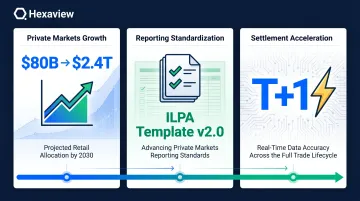
- Private markets growth: Deloitte predicts US retail investors' allocations to private capital will grow from $80 billion to $2.4 trillion by 2030
- ILPA standardization: Reporting Template v2.0 (January 2025) advances standardization of private markets reporting
- Settlement acceleration: T+1 settlement demands real-time accuracy across the trade lifecycle
Industry-Level Impact: Operational, Business, and Workforce Dimensions
Operational impact: Automated data pipelines reduce reconciliation errors, compress reporting cycles, and improve accuracy. Firms implementing AI-driven data solutions report outcomes like 97% rise in data accuracy and 20,000+ man-hours saved in analysis.
Business impact: Modernized data infrastructure unlocks new revenue streams:
- Better risk-adjusted portfolio construction
- Faster product launches
- Data-driven client acquisition
- One large bank projected 10% revenue increase through hyper-personalization and scaled analytics
Workforce impact: CDOs and CIOs evolve from policy enforcement to strategic enablement. 90% of financial services leaders believe their organization needs significant adjustments or total transformation of reskilling strategy to support an AI-powered future.
Future Signals: What to Watch in the Next 1–3 Years
The pace of change is accelerating faster than many firms anticipated. Tim Lind at DTCC frames the stakes directly: "We are going to see more progress in the next two to three years than the industry has seen in the past two decades."
Three developments to monitor:
AI agents managing investment lifecycle segments autonomously: WEF confirms AI agents are processing inquiries, actioning requests, and making product recommendations without human intervention. McKinsey describes collateral inspection agents using computer vision to screen for fraud.
Private markets data standardization: ILPA's Template v2.0 and projected 30x growth in retail allocations will accelerate data standardization demand, making illiquid assets as accessible as public market data.
Data intelligence as managed service: Cloud and AI will mask underlying complexity, shifting industry focus to data intelligence rather than data engineering mechanics—enabling firms to consume data capabilities without building infrastructure.
Strategic Framing: Continuous Adaptation is the New Baseline
Firms that modernize incrementally—connecting workflows and systems step-by-step rather than waiting for complete overhauls—position themselves to compete. A data strategy should never be "finished." The firms gaining ground today aren't those with the largest budgets—they're the ones treating data modernization as an ongoing discipline rather than a one-time project.
Frequently Asked Questions
What is data management in finance?
Financial data management covers the tools, processes, and governance frameworks organizations use to collect, store, analyze, and protect financial information. It enables accurate reporting, regulatory compliance, and informed decision-making across trading, risk management, and client services.
What are the 5 steps to data management?
The core lifecycle has five stages: Definition (identify what data is needed and why), Collection (establish governance and sourcing), Cleaning and validation (ensure accuracy and consistency), Analysis (extract insights through visualization and modeling), and Application (trigger automated workflows or inform strategic decisions).
What are the 4 pillars of data management?
The four foundational pillars are data quality (accuracy and consistency across systems), data governance (policies, ownership, and compliance frameworks), data security (protection and access control), and data integration (direct connectivity across platforms, removing data silos).
What is client data management?
Client data management in wealth management means unifying client information — financial profiles, transaction history, preferences, and life events — for real-time use. It supports personalized service, proactive advisory, and compliance with KYC/AML obligations.
What are the 5 C's of data management?
The 5 C's are Completeness (all relevant data captured), Consistency (uniform across systems), Currency (up to date), Correctness (accurate and error-free), and Compliance (meets regulatory and audit standards). Together, they define what trustworthy financial data looks like in practice.