The ROI Imperative for AI Automation in FinTech & Wealth Management
FinTech and wealth management firms are absorbing pressure from every angle. Compliance demands keep escalating — the SEC alone has imposed $2.3 billion in penalties across 95 enforcement actions for record-keeping violations since fiscal year 2022, and FINRA fines jumped 27% to $75 million in 2025.
Client expectations for real-time service are rising, margins are shrinking, and talent costs keep climbing. Manual workflows make all of it worse.
The reality is stark: financial advisors spend 59% of their time on administrative tasks, leaving just 20% for actual client meetings. This administrative burden doesn't just waste time — it directly erodes profitability and competitive positioning.
AI workflow automation is a direct driver of advisor productivity and firm profitability — not an IT project to defer. Firms automating strategically are pulling ahead, with top performers seeing roughly $3 back for every $1 invested in AI.
This article covers the FinTech and wealth management use cases delivering the fastest ROI, a framework for calculating returns, the four pillars of effective automation, and the mistakes that kill ROI before it starts.
Key Takeaways
- AI workflow automation delivers measurable ROI through cost reduction, compliance efficiency, faster client onboarding, and advisor productivity gains
- Top ROI use cases include KYC/AML automation, regulatory reporting, portfolio rebalancing, financial close reconciliation, and automated client reporting
- ROI = (Net Financial Benefits − Automation Investment Cost) / Investment Cost × 100, measured across time savings, error rates, throughput, and risk reduction
- Four factors drive success: process intelligence, integration architecture, compliance guardrails, and continuous monitoring
- Starting small with one high-impact workflow and scaling from measurable wins delivers faster returns than broad-scope transformations
Why FinTech & Wealth Management Firms Have the Most to Gain from AI Automation
Financial services firms have more to gain from automation than almost any other sector. High transaction volumes, regulatory reporting burdens, and advisor time lost to back-office tasks create measurable inefficiencies — and measurable opportunities.
The Advisor Productivity Gap
The numbers are stark. According to Fidelity's 2025 research, 59% of advisor time goes to administration, compliance, and other non-client tasks. Only 41% supports clients and prospects. Reallocating just five hours per week from administrative work to client-facing activities could generate $270,000 in new revenue per advisor annually.
Automation shifts this ratio. By eliminating manual data entry, automating report generation, and streamlining compliance workflows, firms enable advisors to serve more clients or grow AUM without adding headcount.
The Compliance Multiplier
In wealth management and FinTech, every manual process carries regulatory and audit risk. Automating these processes doesn't just save time—it reduces risk exposure materially.
Recent enforcement data puts the stakes in dollar terms:
- SEC book-and-record penalties: $2.3 billion since FY2022
- FINRA fines: Rose from $59.8 million (2024) to $75 million (2025)
- Global AML/KYC penalties: $3.8 billion in 2025, with the US accounting for $1.676 billion
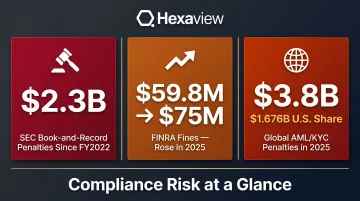
Automated workflows with embedded audit trails, validation checks, and compliance guardrails address this directly. Each process step is logged, defensible, and ready for examiner review — turning a common liability into a documented control.
Beyond "Big Bank" Automation
Mid-market wealth managers, RIAs, and FinTech startups benefit equally—often more—from automation. They lack large operations teams and need to scale lean. A solo advisor managing 73 clients can increase capacity to 120 clients with proper operational support, boosting net take-home pay from $155,000 to $279,000 according to Kitces Research.
Automation delivers that capacity without proportional headcount growth — and the tools that once required enterprise-scale IT budgets are now accessible to firms with 10 advisors or 10,000.
High-ROI AI Workflow Automation Use Cases in FinTech & Wealth Management
ROI comes fastest when automation targets high-frequency, high-stakes workflows—the ones consuming the most manual hours and carrying the highest error costs. Each use case below follows the same pattern: AI handles data processing and routing, automation handles orchestration, humans handle exceptions.
Automated KYC/AML and Client Onboarding
Manual KYC/AML review creates onboarding delays that cost firms both client conversions and compliance risk. According to Fenergo's 2023 survey of 1,000+ C-suite executives, 40% of banks take 31-60 days to complete a single corporate client KYC review. Per-review costs range from $1,501 to $3,500. For banks onboarding 10,000 clients annually, total KYC costs can reach $35 million.
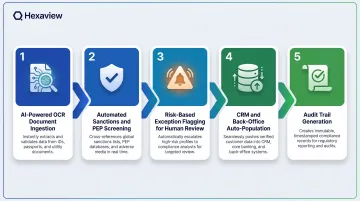
The automated workflow:
- AI-powered OCR ingests identity documents, financial statements, and supporting documentation
- Automated sanctions screening runs against PEP (Politically Exposed Persons) and watchlist databases
- Exception cases flag for human review based on risk thresholds
- Approved cases auto-populate CRM and back-office systems
- Complete audit trail captures every decision point
Automation enables straight-through processing for low-to-medium risk cases while maintaining human oversight where required. The compliance benefit is measurable: 90% of surveyed banks stated that manual processes negatively impact their ability to make accurate risk decisions.
Regulatory Reporting and Audit Trail Automation
Generating periodic regulatory reports—Form ADV, FINRA filings, CFTC reporting—manually requires hours of data aggregation across siloed systems. Each filing carries distinct deadlines, data requirements, and amendment protocols.
AI automation pulls from multiple data sources, validates entries against regulatory schemas, generates draft reports, and maintains a complete audit log. Both changes reduce preparation time and compliance risk.
Firms should also verify that any automation partner holds SOC 2 Type 2 certification. This standard assesses controls around security, availability, processing integrity, confidentiality, and privacy—the exact governance requirements that regulatory examiners scrutinize.
Key benefits:
- Elimination of manual data aggregation across systems
- Automated validation against filing requirements
- Version control and amendment tracking
- Complete audit trail for regulatory examination
- Reduced preparation time and error rates
Portfolio Rebalancing and Trade Operations
Wealth management firms using rule-based rebalancing workflows can automate drift detection, order generation, and compliance pre-trade checks. AI adds intelligence by identifying tax-loss harvesting opportunities or client restriction violations before trades execute.
The numbers make the case clearly. Manual rebalancing takes approximately 20 minutes per client household. For 200 households with two rebalances annually, manual processing consumes 133 hours at a labor cost of nearly $20,000. Automated rebalancing software costs approximately $7,500 annually, yielding $12,500 in net annual savings.
Error reduction matters equally. Manual rebalancing error rates can reach 8-12%, stemming from calculation mistakes, data entry errors, and oversight of complex portfolio interactions. Automation reduces rebalancing costs by 60-70% through optimized trade generation and improved execution efficiency.
Financial Close and Reconciliation Automation
AI-powered reconciliation automation matches transactions across custodians, flags discrepancies, and routes exceptions for review. A process that once took days now runs overnight or in real time.
According to CLA Digital's analysis, accelerating and stabilizing the close ranks among the highest-ROI automation initiatives in financial operations. Specific high-value applications include transaction processing and reconciliations using machine learning to apply coding logic and flag exceptions.
Automation can achieve 30-50% reduction in close time, with error reduction of up to 90%. ROI is typically visible within the first few months of implementation.
AI-Powered Client Reporting and Advisor Productivity
Automated client reporting workflows aggregate portfolio data, generate personalized performance reports, and distribute them on schedule—freeing advisor time for planning and relationship work.
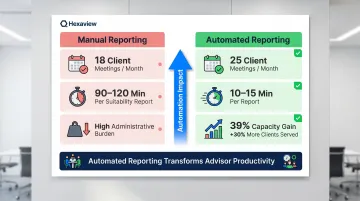
According to Aveni's 2025 research, manual suitability report creation takes 90-120 minutes per report. AI automation reduces this to 10-15 minutes—an 83-92% time savings.
| Report Type | Manual Time | Automated Time | Time Savings |
|---|---|---|---|
| Initial Suitability Report | 90-120 min | 10-15 min | 83-92% |
| Annual Review Report | 60-90 min | 8-12 min | 80-91% |
| Fund Switch Report | 60-90 min | 10-15 min | 75-89% |
The productivity impact extends beyond individual reports. Advisors using automated reporting increased client meetings from 18 to 25 per month—a 39% capacity gain. One adviser served 30% more clients annually without increasing working hours.
Hexaview Technologies has spent over a decade building automation solutions specifically for capital markets and wealth management, working with firms managing $5 trillion+ in assets. Recognitions like WealthTech 100 (2023) and DATATECH50 (2025) reflect delivery track record—not just technical capability. SOC 2 Type 2 certification means the compliance controls are already in place before implementation begins.
How to Measure and Calculate AI Automation ROI in Financial Services
The Core ROI Formula
ROI = (Net Financial Benefits − Total Automation Investment Cost) / Total Automation Investment Cost × 100
"Net financial benefits" must include both hard savings and soft benefits:
Hard savings:
- Labor cost reduction from eliminated manual work
- Error remediation costs avoided
- Reduced compliance penalties and audit costs
Soft benefits:
- Risk reduction from improved compliance controls
- Faster revenue cycles from accelerated onboarding
- Improved client retention from better service delivery
Key Metrics to Baseline and Track
Financial services-specific metrics to measure before and after automation:
- Hours saved per workflow per month — quantify time reclaimed from specific processes
- Error rate reduction — measure accuracy improvements in reporting and reconciliation
- Client onboarding time reduction — track days from application to account activation
- Advisor capacity increase — measure clients served per advisor or AUM per advisor
- Compliance incident rate reduction — track regulatory filing errors, audit findings, or control failures
Investment Cost Components
Calculate total investment cost honestly, including:
- Software/platform licensing fees
- Integration development and API connections
- Staff training and change management
- Ongoing maintenance and support
- Third-party consulting or implementation services
Integration and governance costs are often higher in regulated industries. Factor them in before setting ROI expectations — timeline projections shift significantly when implementation costs are fully accounted for.
Timeline Realism
Some financial services automation workflows show ROI quickly. Document ingestion or report generation can deliver returns within 60-90 days. Broader transformation programs typically require 12-24 months for full-scale returns.
The industry data supports patience. Early AI adopters report an average gain of $1.41 for every dollar spent, according to Snowflake's 2025 survey of 1,900 business leaders — though that's cross-industry. McKinsey's 2026 analysis of top performers found $3 returned per $1 invested, with most companies generating positive cash flow after 1-2 years and significant profit boosts 2-4 years post-deployment.
Indirect ROI in Financial Services
Quantify indirect benefits — even rough estimates count:
- Reduced regulatory penalties — estimate probability and cost of violations prevented
- Audit remediation cost avoidance — calculate time and cost saved on compliance audits
- Improved client satisfaction — track NPS improvements and retention rates
- Increased advisor retention — measure reduced turnover from administrative burnout reduction
When building your business case, model these indirect benefits separately — they frequently shift a marginal ROI projection into a clear approval.
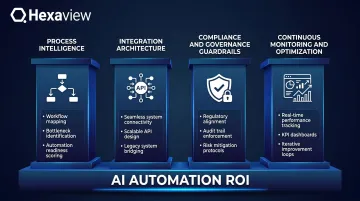
The 4 Pillars of AI Workflow Automation That Actually Deliver in Financial Services
Pillar 1: Process Intelligence
Before automating, map current workflows to identify where manual steps occur, what data moves between systems, and where errors originate. Automation built on a broken process amplifies the problem.
In financial services, a process audit typically reveals that 20-30% of manual steps are redundant or legacy-driven — inherited from workflows designed for a different regulatory era. Document the current state honestly before designing the future state.
Key questions to answer:
- What triggers this workflow?
- Where does data originate and where does it need to go?
- What validation or approval steps are required?
- Where do errors typically occur?
- Which steps are regulatory requirements vs. internal policy?
Pillar 2: Integration Architecture
Financial firms run on fragmented tech stacks. CRMs, portfolio management systems, custodians, compliance tools, and data warehouses rarely communicate natively. AI automation requires an API-first or event-driven integration layer to enable real-time data flow without manual reconciliation.
The integration layer must handle:
- Multiple custodian data formats and delivery protocols
- Portfolio management system APIs
- CRM data synchronization
- Compliance tool connectivity
- Data warehouse or analytics platform feeds
Without proper integration architecture, automation creates data silos instead of eliminating them.
Pillar 3: Compliance and Governance Guardrails
A well-integrated system still fails regulators if it lacks oversight. In FinTech and wealth management, automation without governance creates regulatory exposure — especially where integrated data flows touch client assets or filings. Effective automation embeds compliance checks within workflows, maintains audit trails, and defines clear human review points.
Required governance elements:
- Audit trail capturing every automated decision
- Exception handling with clear escalation rules
- Data validation against regulatory requirements
- Role-based access controls
- Change management protocols
Any third-party automation partner should maintain SOC 2 Type 2 certification. This ensures controls are in place for security, availability, processing integrity, confidentiality, and privacy—all critical for financial services compliance.
Pillar 4: Continuous Monitoring and Optimization
Define KPIs from day one, monitor workflow performance through dashboards, and build a quarterly review cadence to catch drift, integration failures, or edge cases before they become compliance events.
The failure data is sobering. 30-50% of RPA projects fail according to EY's financial services research. Deloitte found that only 3% of companies successfully scale RPA initiatives to enterprise level.
The firms that make it into that 3% treat monitoring as a core deliverable — not an afterthought added after the first failure.
Common Pitfalls That Kill AI Automation ROI in Financial Services
Pitfall 1: Automating Broken Processes
Many firms launch automation on top of inconsistent data, unclear ownership, or legacy exception-handling rules. AI amplifies whatever inputs it receives—including errors and inconsistencies.
The path forward: standardize data schemas and document current-state workflows first. Identify inefficiencies, redesign the process itself, then build automation on top of a clean foundation.
Pitfall 2: Underestimating Compliance Complexity
Automation in financial services that doesn't account for regulatory nuance creates liability. Jurisdiction-specific reporting rules, audit log requirements, and data residency laws all impact implementation.
That liability compounds quickly when working with general-purpose automation tools that lack financial services depth. Partners with hands-on SEC and FINRA experience deliver production-ready implementations — not just proof-of-concept pilots that stall at the compliance review stage.
Pitfall 3: Big-Bang Implementation Without Pilots
Attempting to automate multiple complex workflows simultaneously delays ROI and increases failure risk. Two-thirds of companies achieving strong AI ROI focused on three or fewer domains rather than broad deployment.
Firms that start with one or two targeted, measurable workflows generate faster wins and build the internal momentum needed to scale. A single successful pilot — with clear metrics attached — does more to advance enterprise-wide adoption than any broad rollout that stumbles out of the gate.
Building Your AI Automation Roadmap: Where to Start
A Practical Three-Step Framework
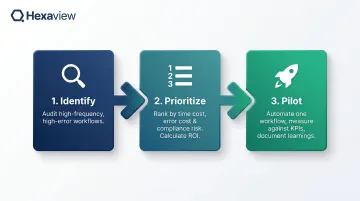
1. Identify — Run a workflow audit to surface the three to five highest-frequency, highest-error manual processes. Look for workflows that:
- Consume significant advisor or operations time
- Generate frequent errors with compliance or client impact
- Require data movement across multiple systems
- Follow predictable, rule-based logic
2. Prioritize — Rank identified workflows by combination of time cost, error cost, and compliance risk. Calculate the potential ROI for each using the formula above. Select the workflow with the highest ROI potential and clearest success metrics.
3. Pilot — Automate one workflow end-to-end, measure results against baseline KPIs, and use learnings to shape the broader roadmap. Document what worked, what didn't, and what integration or governance challenges emerged.
Choosing the Right Automation Partner
Those pilot results will quickly reveal something equally important: the right automation partner matters as much as the right workflow. Choose one with deep FinTech and wealth management domain expertise, not just technical capability. Compliance-aware implementation, understanding of custodian data formats, and familiarity with advisor workflows determine how quickly production-ready automation can be deployed.
Hexaview brings over 10 years of capital markets and wealth management experience, SOC 2 Type 2 certification, and proven AI automation delivery for financial services firms. That domain depth means fewer integration surprises, faster compliance sign-off, and automation that advisors and operations teams actually adopt.
Next Steps
Schedule an automation readiness assessment to identify your highest-ROI automation opportunities before committing to a platform or build scope. The assessment typically surfaces two to three high-impact workflows within the first engagement, giving you a concrete starting point and a realistic implementation timeline.
Frequently Asked Questions
Frequently Asked Questions
How to calculate ROI for automation?
ROI = (Net Financial Benefits − Investment Cost) / Investment Cost × 100. Factor in both hard savings (labor, error costs) and soft savings (risk reduction, faster revenue cycles), measured against total investment including licensing, integration, training, and maintenance.
Will RPA be replaced by AI?
RPA handles rule-based, structured tasks; AI handles unstructured data, judgment, and exceptions like document interpretation and anomaly detection. In financial services, the most effective automation combines both rather than replacing one with the other.
What are the 4 pillars of automation?
The four pillars are:
- Process Intelligence: Map workflows before automating to surface inefficiencies
- Integration Architecture: Build API-first connectivity across fragmented systems
- Compliance and Governance Guardrails: Embed regulatory controls and audit trails
- Continuous Monitoring and Optimization: Track performance and catch drift over time
What are the best AI automation use cases for wealth management firms?
KYC/AML onboarding, portfolio rebalancing, regulatory reporting, financial close reconciliation, and automated client reporting deliver the fastest and most measurable ROI. Each addresses high-frequency, high-error workflows while reducing compliance risk and freeing advisor capacity for client-facing work.
How long does it take to see ROI from AI workflow automation in financial services?
Targeted workflows like document ingestion or reconciliation can show ROI within 60-90 days; enterprise-wide programs typically require 12-24 months. Starting with a pilot delivers early wins and builds confidence before scaling.