Introduction
Picture a hedge fund analyst's morning: pulling data from Bloomberg terminals, reconciling reports from three different prime brokers and custodians, manually compiling a risk summary, and preparing an investor update — all before the market opens. By the time the real analytical work begins, half the morning is gone.
This scenario plays out daily across the industry. Financial advisors spend just 15% of their time on investment management, with the rest consumed by client service, planning, and operational tasks.
Hedge funds and asset managers operate where speed, accuracy, and compliance are non-negotiable — yet repetitive, data-intensive tasks that require no human judgment consume a significant share of operational capacity. That structural drag hits both performance and analyst morale.
This article covers what AI agent workflow automation is, why it matters for financial firms, where it delivers the highest ROI, and how to implement it within the compliance guardrails regulated environments require.
TLDR
- AI agents autonomously execute multi-step financial processes — perceiving inputs, reasoning about context, and taking action
- Fragmented data, manual reporting cycles, compliance demands, and LP transparency pressure create compounding operational drag for hedge funds
- Top ROI use cases: portfolio monitoring, regulatory reporting, investor communications, due diligence, and trade operations
- Start with lower-risk workflows, build trust with human oversight, then expand deployment in phases
- Vet implementation partners for SOC 2 Type 2 certification and capital markets regulatory experience
What Is AI Agent Workflow Automation?
AI agent workflow automation is a system where intelligent agents autonomously execute multi-step business processes — reading data inputs, reasoning about context, and selecting the right action for the situation. Unlike simple bots or robotic process automation (RPA) tools, these agents adapt dynamically rather than following a hard-coded script.
How It Differs from Traditional Rule-Based Automation
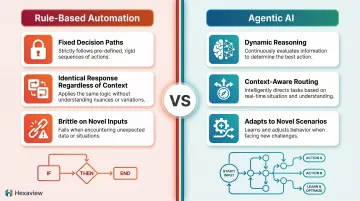
In conventional automation, every step and decision path is predefined — the system always follows the same route regardless of context. Agentic workflows break from this by letting the agent interpret ambiguous inputs and choose its path based on what's actually happening.
Consider a concrete financial example. A static automation escalates every compliance flag the same way, regardless of severity. An AI agent reads the flag's full context — transaction size, counterparty risk rating, historical patterns, regulatory environment — then routes it accordingly:
- Minor flags → automated documentation
- Moderate issues → compliance review queue
- Critical concerns → chief compliance officer, with a preliminary risk assessment already drafted
Gartner defines agentic AI as a "goal-driven digital workforce that autonomously makes plans and takes actions," distinguishing it from rule-based RPA that follows predetermined scripts.
Why this distinction matters for finance:
Financial workflows are complex, context-dependent, and data-rich. The same trade flag, investor inquiry, or market event can require entirely different responses depending on context — making static rule-based systems brittle and agentic approaches a natural fit. McKinsey estimates AI could impact 25% to 40% of an average asset manager's cost base, but only if systems can handle the judgment-intensive workflows that consume the most expensive human capital.
Why Hedge Funds and Asset Managers Need Agentic AI Now
The Operational Burden Is Growing
Asset managers allocate 60% to 80% of their technology budgets to "run-the-business" operational maintenance rather than innovation. Only 5-10% of total tech spend goes toward firmwide digital transformation. Meanwhile, 43% of hedge funds cite compliance and regulatory requirements as a key cost pressure.
Modern hedge funds draw data from Bloomberg, Refinitiv, prime brokers, custodians, risk engines, factor models, and internal systems. Analysts routinely spend hours reconciling these sources — time directly subtracted from actual investment work.
Nearly 2,000 new regulatory data fields were created between 2014 and 2023, compounding the documentation burden on already stretched teams.
Competitive and Investor Pressure Is Accelerating
Firms that automate routine operational workflows — reporting, data reconciliation, compliance tracking — free their analysts to focus on higher-value work: building models, evaluating positions, and refining strategy. 95% of hedge funds surveyed by AIMA now use generative AI in some capacity, up from 86% in 2023. For most funds, AI has moved from pilot project to core operational expectation.
LP expectations have evolved fundamentally:
- Over 90% of institutional investors believe AI will transform portfolio monitoring
- 80% of investors expect higher transparency from fund managers, particularly at the individual asset level
Manual reporting cycles built around quarterly deliverables are structurally incompatible with these expectations.
60% of investors are more likely to allocate to managers making meaningful investments in AI — making technology adoption a direct factor in capital raising, not just operations.
That pressure extends internally, too. Skilled analysts recruited for judgment and domain expertise increasingly leave environments where most of their time goes to data wrangling. Workflow automation has become a retention issue as much as an efficiency one.
Key Components of an Agentic AI Workflow
How the Architecture Works
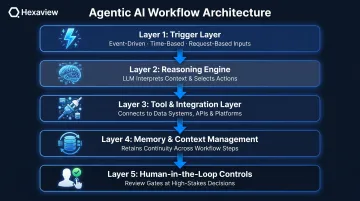
Trigger layer: What initiates an agentic workflow in financial contexts:
- Portfolio position breaching a risk threshold
- Regulatory filing deadline approaching on compliance calendar
- New earnings release hitting a monitored ticker
- Investor submitting a query through the client portal
Triggers can be event-driven, time-based, or request-based — and the same architecture handles all three.
Reasoning engine (LLM core): Unlike a static rule engine, the LLM core handles novel inputs, ambiguous requests, and multi-step dependencies without requiring every scenario to be pre-programmed. It receives the trigger and available context, determines the workflow goal, then decides which tools to deploy and in what sequence.
Tool and integration layer: Agents connect to financial data APIs, portfolio management systems, CRM platforms (such as Salesforce), compliance tracking tools, document repositories, and data warehouses to retrieve, process, and push data. The breadth of this integration layer determines what the agent can accomplish autonomously.
Memory and context management: Agents maintain continuity across multi-step workflows — retaining the context of a prior investor inquiry when generating a follow-up report, or carrying forward risk parameters established earlier in a compliance workflow. Without effective context management, agents produce fragmented, inconsistent outputs.
Human-in-the-loop controls: Investor-facing communications, regulatory filings, trade flags, and compliance decisions require human review gates embedded in the workflow architecture. These checkpoints preserve efficiency while keeping humans accountable at every high-stakes decision point.
High-Impact Use Cases for Hedge Funds and Asset Managers
Where AI Agents Deliver the Biggest ROI
Portfolio Monitoring and Anomaly Detection
AI agents continuously ingest live market data, portfolio positions, and risk metrics, automatically generating alerts and structured preliminary analysis memos when defined thresholds are breached. Hedge funds using LLMs from Anthropic, OpenAI, and Microsoft now complete tasks that previously required analysts more than an hour in seconds.
This compresses the time from market signal to analyst awareness from hours to minutes, tightening decision cycles and improving risk response times.
Regulatory and Compliance Reporting Automation
Agents compile data across systems to auto-draft regulatory filings (Form 13F, Form ADV updates), prepare audit-ready compliance reports, and assemble responses to investor due diligence questionnaires (DDQs).
Hedge funds face extensive regulatory obligations:
| Filing | Authority | Frequency | Deadline | Threshold |
|---|---|---|---|---|
| Form 13F | SEC | Quarterly | 45 days post-quarter | >$100M in 13(f) securities |
| Form ADV | SEC | Annual + amendments | 90 days post-fiscal year | All SEC-registered advisers |
| Form PF | SEC/CFTC | Quarterly (large) | 60 days post-quarter | >$1.5B hedge fund AUM |
| AIFMD Annex IV | ESMA/FCA | Quarterly/Semi-annual | Per regulator | EU/UK alternative managers |
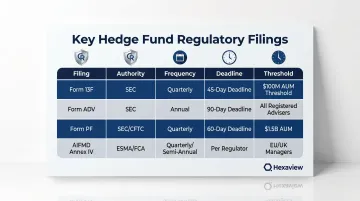
Manual processes for these filings create bottlenecks and error risk. Agentic automation offers direct cost containment while improving accuracy and audit readiness.
Investor Relations and Reporting
Agents aggregate fund performance data, generate draft investor letters and quarterly reports, and personalize communications based on LP-specific exposures or preferences. What previously required days of analyst effort across multiple systems compresses to a structured, reviewable draft produced in hours. Firms prioritizing clear, consistent reporting achieve fundraising goals 20% faster.
Due Diligence and Research Workflows
Agents ingest, parse, and synthesize company filings (10-Ks, 8-Ks), earnings call transcripts, news feeds, and alternative data sources. Analysts receive structured briefings with key metrics, risk factors, and sentiment signals extracted — processed intelligence rather than raw data sets.
Domain Expertise in Capital Markets Automation
Each of these workflows requires more than off-the-shelf automation — financial data is sensitive, regulatory stakes are high, and integration across custodians and systems is rarely straightforward. Hexaview Technologies brings over 10 years of capital markets and wealth management experience, SOC 2 Type 2 certification, and WealthTech 100 recognition to these engagements. The team builds AI agent workflows purpose-fit for financial firms, with hands-on delivery across multi-custodian data integration, automated reporting pipelines, and enterprise financial system orchestration.
Implementing AI Agent Workflow Automation: A Phased Approach
A Phased Approach for Financial Firms
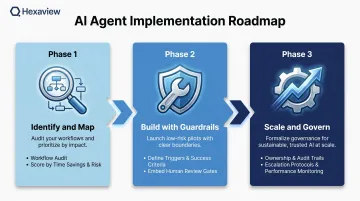
Phase 1 — Identify and map:
Conduct a workflow audit to surface the highest-volume, most repetitive processes in your firm:
- Daily risk reporting
- Data reconciliation
- Compliance monitoring
- Client communication cycles
Score candidates by two dimensions: potential time savings and implementation risk. Prioritize workflows that are high-frequency, rule-heavy in structure, and not directly client-facing or regulatory-critical as your starting point.
Phase 2 — Build with guardrails:
Implement AI agents on lower-risk workflows first. Define:
- Triggers (what initiates the workflow)
- Expected outputs (what the agent should produce)
- Success criteria (accuracy thresholds, performance benchmarks)
Embed human review checkpoints at any output that influences client communications, trade decisions, or regulatory submissions. Measure accuracy against manual baselines before expanding scope.
Phase 3 — Scale and govern:
Once early pilots demonstrate accuracy and reliability, extend agent automation to more complex or sensitive workflows — with a formal governance framework in place covering:
- Ownership (who monitors and updates each automation)
- Audit trails (complete logging of agent actions)
- Escalation protocols (when to elevate to human review)
- Continuous performance monitoring (accuracy tracking over time)
Governance at this stage introduces real complexity — and that's where a technology partner with both AI engineering depth and financial services experience makes a measurable difference. Firms like Hexaview Technologies, with over 10 years in capital markets and SOC 2 Type 2 certification, bring pre-built integration templates, regulatory compliance frameworks, and deployment patterns refined across fintech and wealth management engagements — cutting months off implementation timelines.
Governance, Security, and Compliance Considerations
Auditability Is Non-Negotiable
Every action taken by an AI agent — data retrievals, calculations, communications drafted, alerts generated — must produce a complete, timestamped audit log. The SEC's 2025 examination priorities explicitly target AI use by registered firms, covering accuracy of representations, policy adequacy, and "AI washing."
Financial regulators (SEC, FINRA, FCA) may require firms to demonstrate the basis for decisions influenced or assisted by AI systems. That means explainability isn't optional — it's an infrastructure requirement.
Design logging and explainability into the architecture from day one. The same rigor applies to the underlying data infrastructure those agents depend on.
Data Security Requirements in Hedge Fund Contexts
AI agents require broad access to sensitive financial data — portfolio holdings, client information, trade records. Deployment should require:
- SOC 2 Type 2 certification at minimum
- End-to-end data encryption
- Role-based access controls
- Clear data residency and retention policies
FINRA guidance emphasizes that "black box" models are unlikely to be operationally deployed due to compliance and audit requirements. Evaluate infrastructure partners against these standards before any production deployment — and verify their certifications, not just their claims. Hexaview, for instance, holds SOC 2 Type 2 certification and has over a decade of experience building compliant systems for capital markets clients.
Governance Over Every Deployed Agent Workflow
Define ownership and oversight protocols for each automation before it goes live:
- Ownership (who is responsible for monitoring and updating each automation)
- Version control for agent configurations
- Review schedules to ensure workflows remain accurate as regulations, data sources, or business processes evolve
Without explicit governance, automated workflows drift or become "shadow automations" that no one monitors or owns — creating operational and regulatory risk.
Frequently Asked Questions
What is AI agent workflow automation?
AI agent workflow automation is a system in which intelligent agents autonomously execute multi-step business processes by perceiving inputs, reasoning about context, and selecting appropriate actions. Unlike static rule-based automation, agents adapt dynamically to varying conditions.
How does agentic AI enable business process and workflow automation?
Agentic AI introduces a reasoning layer into workflows: instead of following a fixed script, the agent interprets inputs, determines which tool or action is most appropriate, and adapts its execution path. This enables automation of complex, context-dependent processes that traditional automation cannot handle.
How does agentic AI impact enterprise workflows and operations?
The operational impact falls into four areas:
- Reduces manual effort on repetitive, high-volume tasks
- Compresses cycle times from data event to actionable output
- Improves accuracy by eliminating human error in data processing
- Scales complex operations without proportional headcount growth
What are the key components and stages of agentic AI?
Every agentic system is built on five layers: a trigger layer, a reasoning engine (the LLM), a tool and integration layer, context/memory management, and human-in-the-loop oversight checkpoints. Together, these determine what the agent perceives, decides, and acts on.
What are the top agentic AI frameworks?
Commonly used frameworks include LangChain, LlamaIndex, AutoGen, and CrewAI, as well as platform-native options like Salesforce Agentforce. The right choice depends on integration requirements, data complexity, compliance needs, and in-house technical capabilities.
How do you design and build an AI agent workflow automation system?
Start by mapping target workflows and defining clear triggers and success criteria. Then integrate relevant data sources, build the reasoning and action layers, and embed human review gates at sensitive decision points. Run low-risk pilots first — comprehensive logging for auditability is non-negotiable before scaling to production.
Considering agentic AI for your firm? Contact Hexaview Technologies at +1 (845) 653 3855 or hello@hexaviewtech.com to discuss how to operationalize AI agent workflows while meeting the governance and security standards required in regulated financial environments.