Introduction
Asset managers and hedge funds face a critical challenge: portfolios are expanding in complexity while market signals multiply exponentially, yet manual analysis methods can't keep pace. Firms relying on quarterly rebalancing and periodic risk reviews now compete against institutions executing trades in microseconds and monitoring thousands of securities continuously. According to NVIDIA's 2025 State of AI in Financial Services report, 52% of financial services firms now use generative AI — up from 40% in 2023 — with usage for trading and portfolio optimization jumping from 13% to 43% year-over-year.
AI-powered portfolio management doesn't replace portfolio managers. It augments their capabilities with machine learning, natural language processing, predictive analytics, and automated execution across the full investment lifecycle: from data ingestion to trade settlement. The technology handles data-intensive pattern recognition, continuous monitoring, and repetitive workflows while humans focus on strategic judgment, client relationships, and contextual decision-making.
TLDR:
- AI enables real-time market monitoring, automated rebalancing, and predictive risk assessment — cutting analysis time by over 90% in documented cases
- Hedge funds deploy AI for algorithmic trading, sentiment analysis, factor investing, and client portfolio personalization at scale
- Top implementation barriers are data quality, model interpretability, and change management; technology availability is rarely the bottleneck
- Hexaview Technologies brings 10+ years of capital markets expertise to production-ready AI deployment
- Early movers gain faster iteration cycles and better-trained models, and that advantage compounds with every additional training cycle
Key AI Capabilities Reshaping Portfolio Management
Multiple authoritative surveys confirm AI adoption in institutional financial services has crossed the majority threshold. The Bank of England and FCA's 2024 AI survey found 75% of UK financial firms now use AI, up from 58% in 2022, with a median of 9 use cases per firm expected to grow to 21. More significantly, the IIF-EY 2025 Annual Survey reports 100% of surveyed financial institutions increased AI/ML investment in 2024, with 50% increasing spend by more than 25%.
The practical impact spans three core investment functions: predictive analytics, sentiment-driven signal generation, and algorithmic execution. Each area compounds the others when deployed together.
Predictive Analytics and Asset Allocation
Machine learning models analyze historical market trends, asset correlations, and economic indicators to forecast price movements and optimize asset mix across investor objectives. Unlike traditional quarterly rebalancing, AI continuously updates allocation recommendations as new data arrives, shifting portfolio construction from a static exercise to a continuous one.
Two model architectures do most of the work here:
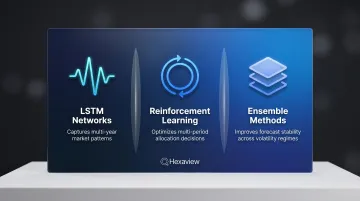
- LSTM networks capture time-series dependencies in market data, identifying patterns across multi-year price histories
- Reinforcement learning models optimize multi-period allocation by treating portfolio construction as a sequential decision problem — learning from market feedback rather than fixed rules
- Ensemble methods combine both approaches to improve forecast stability across different volatility regimes
The shift from periodic to continuous rebalancing represents a fundamental change in operational tempo. Traditional models evaluate allocations quarterly; AI-driven systems monitor drift in real time and trigger rebalancing trades when thresholds breach, with no manual intervention required.
Sentiment Analysis and Alternative Data
Natural language processing models process unstructured data — earnings call transcripts, news feeds, regulatory filings, social media — to quantify market sentiment and detect early signals of sector shifts or company-level risk before they surface in price data.
Coalition Greenwich's 2025 study of 56 buy-side firms found 63% plan to increase spending on alternative data, driven largely by generative AI capabilities. Almost 50% of buy-side professionals describe themselves as "medium-frequency users" of alternative data.
This rise reflects "quantamental" investing — AI integrating quantitative signals with qualitative narrative context. Quant funds gained 12% for the year ending March 2024, per an index compiled by Société Générale, demonstrating that blending fundamental analysis with machine learning delivers measurable performance.
Algorithmic Trading and Execution
AI-powered trading systems analyze market data in microseconds and execute large orders by breaking them into smaller tranches to minimize market impact. Trading rules update automatically as market conditions shift — no manual rule changes needed.
Statistical arbitrage represents a key hedge fund use case: ML models detect rapid price discrepancies in correlated securities and execute trades to capture fleeting spreads. These opportunities disappear in seconds; no human trader can react fast enough to capture them.
Beyond speed, AI improves execution quality across three dimensions:
- Order routing: learns optimal venue selection from historical fill data to reduce slippage
- Trade timing: identifies intraday liquidity patterns to minimize market impact on large positions
- Position sizing: dynamically adjusts tranche sizes based on real-time order book depth
How AI Automates Critical Workflows for Hedge Funds and Asset Managers
Beyond investment decisions, institutional operational costs concentrate in repetitive, rule-based workflows — reporting, compliance checks, rebalancing triggers, client communications. AI automation of these workflows delivers the fastest ROI.
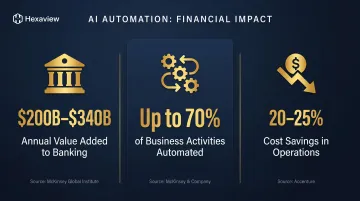
McKinsey's 2023 analysis estimates generative AI could add $200 billion to $340 billion annually to banking sector value, equivalent to 9 to 15% of operating profits. The firm projects GenAI could enable automation of up to 70% of business activities across industries. Accenture reports AI-driven banking operations achieve 20-25% cost savings and enhance operational efficiency by up to 50%.
Automated Portfolio Rebalancing
AI systems continuously monitor portfolio drift against target allocations and trigger rebalancing trades when thresholds breach, with no human intervention required. Tax-loss harvesting runs simultaneously to optimize after-tax returns, particularly valuable for separately managed accounts.
AQR's peer-reviewed study (Journal of Beta Investment Strategies, 2022) quantifies tax alpha from direct indexing at 339 basis points in Year 1 for investors offsetting short-term capital gains, decaying to approximately 20 basis points long-run without additional capital contributions.
High-net-worth investors with hedge fund allocations derive the highest benefits due to systematic short-term gains.
The operational benefit extends beyond tax efficiency. Automated rebalancing eliminates the manual workflow of monitoring hundreds of accounts, calculating drift, and generating trade tickets, freeing portfolio managers to focus on mandate customization and client strategy.
Compliance and Regulatory Reporting
AI automates the extraction, validation, and formatting of data for regulatory filings, reducing both labor cost and error rate. Supported filing types include:
- 13F quarterly holdings disclosures
- Form ADV registration and amendment filings
- AIFMD reports for EU-regulated fund structures
The Bank of England/FCA survey finds 33% of all AI use cases are now third-party implementations, up from 17% in 2022, reflecting growing vendor maturity in compliance automation. Firms deploying these systems in regulated environments should verify security credentials — SOC 2 Type 2 certification and ISO-certified infrastructure are baseline requirements.
Client Reporting and Personalization at Scale
Generative AI combined with portfolio data systems enables automated generation of personalized client commentary and performance reports — covering portfolio attribution, risk metrics, and market context — at a scale impossible with manual processes.
For wealth managers and family offices managing hundreds of bespoke mandates, this is where AI delivers outsized leverage. One bank in McKinsey's research cut investment brief production time by more than 90%, from nine hours to 30 minutes, using generative AI.
Multi-Agent AI Systems for Research and Decision Support
Emerging multi-agent AI frameworks assign specialized agents to distinct tasks: one monitoring macro signals, another screening earnings releases, another flagging risk breaches. These agents surface synthesized recommendations to portfolio managers in real time.
The architecture mirrors how investment teams already work — different analysts covering different sectors — but runs continuously and processes millions of data points across global markets that no human team could track in parallel.
AI-Powered Risk Management: From Early Warning to Real-Time Mitigation
Risk management is where AI delivers its highest-stakes results in portfolio management. Traditional models were backward-looking and periodic. AI makes continuous, forward-looking, multi-dimensional risk assessment possible — a practical necessity for hedge funds operating through volatile macro and geopolitical cycles.
The Financial Stability Board's November 2024 report warns that "market correlations" caused by widespread use of similar AI models and training data across institutions creates systemic vulnerability. Existing regulatory frameworks "address many vulnerabilities" but "more work may be needed."
Real-Time Market Monitoring and Anomaly Detection
AI models continuously ingest streaming market data — price feeds, volatility indices, credit spreads, alternative data — to detect anomalies signaling emerging market stress, counterparty risk, or liquidity deterioration well before they appear in conventional risk reports.
The IIF-EY 2024 survey reports 32 institutions use predictive AI as a key risk management tool, including for surveillance and anomaly detection. 87% employ ongoing performance monitoring for AI models, and 85% maintain "human-in-the-loop" controls.
Stress Testing and Scenario Simulation
ML-powered stress testing simulates portfolio performance across hundreds of hypothetical market scenarios, including synthetic scenarios generated when historical analogues don't exist. This gives risk managers a broader view of tail risk than traditional scenario analysis provides.

During the 2020 pandemic, historical data offered limited guidance. AI systems capable of generating synthetic stress scenarios from fundamental relationships — rather than pattern-matching against prior events — delivered meaningfully better risk visibility when it mattered most.
Credit Risk and Counterparty Assessment
AI enables continuous, real-time credit risk assessment of assets and counterparties within the portfolio, using dynamic scoring models that incorporate both structured financial data and unstructured signals (news, supply chain disruption indicators).
Moving from periodic credit reviews to always-on monitoring closes the gap between emerging credit stress and portfolio action. For high-yield and distressed debt strategies, that lag reduction can be the difference between a managed exit and a forced one.
Behavioral Risk Modeling and Bias Reduction
AI-driven risk models identify patterns of cognitive bias in historical decision-making and alert managers to deviations before they compound. Common patterns flagged include:
- Over-concentration in familiar sectors despite portfolio mandates
- Delayed stop-loss execution relative to pre-defined risk thresholds
- Recency bias in position sizing during momentum-driven markets
Markets aren't the only source of portfolio risk. Systematic decision-making flaws embedded in discretionary strategies carry real cost — and AI is well-suited to surface them before they become structural problems.
Measurable Benefits Driving Institutional AI Adoption
NVIDIA's 2025 report finds 76% of managers report revenue increases of 5% or more from AI, with 23% reporting over 20% increases. Over 80% predict a 2x or greater return on AI investments. These are realized outcomes from institutions already running AI in production.
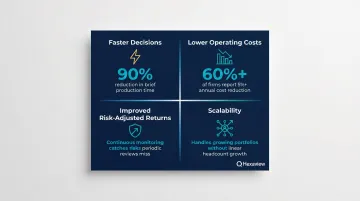
Four core benefit categories drive adoption:
- Faster, higher-quality decisions: AI analyzes thousands of securities simultaneously, processes unstructured data at scale, and surfaces patterns that escape manual review. McKinsey documents one bank cutting investment brief production by over 90% — from nine hours to 30 minutes.
- Lower operating costs: Over 60% of firms report 5%+ annual cost reduction from AI, with 12% reporting over 20% (NVIDIA 2025). Accenture's case study showed agentic AI made development 30% more efficient, saving an estimated $19 million.
- Improved risk-adjusted returns: Continuous monitoring and anomaly detection catch emerging risks that periodic reviews miss. Quantamental funds blending AI with fundamental analysis posted strong results through volatile 2024 markets.
- Scalability without proportional headcount growth: AI handles expanding security universes without linear cost increases — an operational advantage that compounds as portfolios grow.
FTI Consulting's 2026 Private Equity AI Radar found 95% of funds report AI initiatives meeting or exceeding original business case criteria, with 41% citing revenue acceleration as the top AI priority.
Competitive pressure is accelerating adoption: more than half of financial firms now identify AI as critical to their success. Early movers build performance and data advantages that are difficult for laggards to close. Better-trained models and faster iteration cycles compound over time.
Navigating the Challenges: Data Quality, Bias, and Human Oversight
The Data Quality Problem
AI models are only as good as their training data. The Bank of England/FCA survey finds 4 of the top 5 perceived AI risks are data-related (privacy, quality, security, bias), and 46% of firms have only a "partial understanding" of the AI technologies they deploy.
Siloed, inconsistent, or historically biased financial datasets produce flawed models. Robust data governance — master data management, validation pipelines, bias auditing — must precede model deployment. Firms that skip this step don't just get inaccurate predictions — they inherit compounding errors at scale.
External research confirms the scope of the problem:
- Gartner's 2024 survey identifies inadequate data quality/availability and low data literacy as the top two AI challenges in finance
- The IIF-EY 2025 survey confirms data quality (16%) and data availability (12%) as the leading production hurdles
The "Black Box" Transparency Challenge
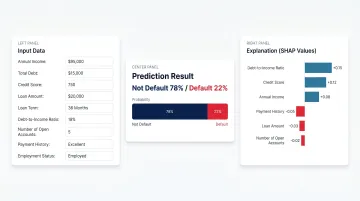
Deep learning models — particularly neural networks used in return prediction — resist easy interpretation, creating real regulatory and fiduciary accountability problems. The IIF-EY survey finds 46% report lack of explainability as a major GenAI concern, while 80% cite hallucinations as the top risk.
Explainable AI (XAI) techniques provide the practical path to auditability:
- SHAP values (Shapley Additive Explanations) — 64% of UK firms specifically use SHAP, per the BoE/FCA survey
- Rule-based overlays that translate model outputs into interpretable decision logic
- Model-agnostic interpretability tools that work across architectures — from gradient boosting to deep neural nets
**81% of UK financial firms use explainability methods** (BoE/FCA 2024) — XAI is no longer optional, it's a regulatory expectation. Asset managers operating in regulated markets must be able to explain, audit, and defend every material AI-driven decision — not just in theory, but on demand.
Human-AI Collaboration Rather Than Full Automation
AI systems struggle with genuinely novel market conditions — geopolitical shocks, black swan events — that have no historical precedent. The FSB is direct on the risk: "misaligned AI systems that are not calibrated to operate within legal, regulatory, and ethical boundaries can engage in behaviour that harms financial stability."
Human portfolio managers remain essential for:
- Contextual judgment during unprecedented market events
- Client trust and relationship management
- Strategic oversight and ethical decision-making
- Governance and accountability
The optimal model: AI handles data-intensive, repetitive, and pattern-recognition tasks while humans focus on judgment calls, relationship management, and ethical oversight. The IIF-EY survey finds 85% maintain "human-in-the-loop" controls and 70% have implemented kill switches or hard blocks for AI systems.
How to Build an AI-Powered Portfolio Management Strategy
Phase 1: Audit and Consolidate Data Infrastructure
Integrate core systems — order management systems (OMS), risk platforms, market data feeds, CRM — into a unified data foundation before deploying AI models. AI trained on fragmented, inconsistent data produces unreliable outputs.
Key steps:
- Map all data sources — identify custodian feeds, market data vendors, internal systems
- Assess data quality — check completeness, accuracy, consistency, timeliness
- Establish governance — define ownership, lineage, access controls, validation rules
- Build integration pipelines — automate data ingestion and transformation
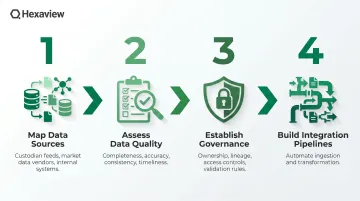
This phase typically takes 2-4 months with experienced implementation partners. Firms with mature data infrastructure can accelerate; those with legacy silos require longer preparation.
Phase 2: Identify High-Value Pilot Use Cases
Start with 2-3 focused pilots where measurable ROI can be demonstrated quickly:
- Automated rebalancing alerts — flag portfolio drift and generate recommended trades
- Sentiment-driven research augmentation — surface relevant news and filings for analyst review
- Compliance reporting automation — generate regulatory filings with reduced manual effort
Pilot selection criteria:
- Clear success metrics (time saved, error reduction, cost decrease)
- Limited scope allowing 3-6 month delivery
- High stakeholder visibility demonstrating value
Hexaview Technologies brings over 10 years of capital markets and wealth management expertise. Clients including LPL Financial and Addepar have accelerated pilot delivery by pairing that domain depth with dedicated AI engineering — reducing the ramp-up that typically stalls early-stage deployments.
Phase 3: Scale Validated Use Cases
Embed AI outputs into existing governance and decision workflows. Scaling requires:
- Model monitoring infrastructure — track performance drift, data quality, accuracy
- Change management — train users, adjust workflows, establish accountability
- Governance frameworks — document models, establish review cycles, define escalation paths
The IIF-EY survey finds 74% of institutions have or plan to appoint a C-suite manager for AI/ML ethics and governance. 70% have already engaged with regulators on AI, up from 53% in 2023.
Build vs. Partner Decision
That governance complexity is precisely where most build-in-house efforts stall. Most asset managers and hedge funds lack the AI engineering depth to build production-grade models that hold up under live market conditions — and hiring for it is increasingly difficult.
FTI Consulting's 2026 PE AI Radar finds 35% of firms cite talent as the primary constraint to scaling AI adoption. The CFA Institute reports that 66% of investment professionals want to develop AI skills — a signal that upskilling through partnership is often more practical than competing for scarce specialists.
Hexaview Technologies combines capital markets domain expertise with production AI engineering, along with the compliance infrastructure institutional clients require:
- SOC 2 Type 2 certification
- Information Security Management System (ISO) credentials
- Data encryption and anonymization standards
- Role-based access controls
- Model documentation structured for regulatory audits
These aren't differentiators — they're table stakes for any financial AI deployment that needs to survive a compliance review.
Frequently Asked Questions
Can I use AI to manage my stock portfolio?
Yes, but distinguish between retail AI tools (robo-advisors) and institutional AI portfolio management systems. Retail tools offer automated rebalancing and tax-loss harvesting for individual investors. Institutional-grade AI involves predictive analytics, multi-asset optimization, and automated compliance designed for professional asset managers and hedge funds managing billions in AUM.
Which AI is best for portfolio management?
No single platform fits every firm. The right choice depends on your use case (trading, risk, reporting), data infrastructure maturity, and regulatory requirements. Evaluate platforms on explainability, integration depth, security certifications (SOC 2, ISO), and the domain track record of your implementation partner.
What are the main use cases of AI in hedge fund management?
Top use cases include algorithmic trading and execution, sentiment analysis for alpha generation, real-time risk monitoring, automated portfolio rebalancing, compliance reporting automation, and multi-agent research workflows surfacing synthesized market intelligence to portfolio managers.
How does AI improve risk management for asset managers?
AI improves risk management by enabling continuous (rather than periodic) monitoring, detecting anomalies in real time, running dynamic stress tests across hundreds of scenarios, and providing early warning signals before risks materialize in NAV or regulatory triggers.
What are the risks of using AI in portfolio management?
Key risks include model bias from poor training data, "black box" decision-making that creates auditability gaps, systemic risk from correlated AI behavior across firms, and latency issues with generative AI in high-frequency contexts. Robust governance, explainability methods, and human oversight keep these risks in check.
How long does it take to implement AI in portfolio management?
A focused pilot (automated risk alerting or compliance reporting) can deliver measurable results in 3-6 months with the right data foundation and an experienced implementation partner. Full-stack AI transformation across trading, risk, and operations typically takes 12-18 months in a phased approach.