Introduction
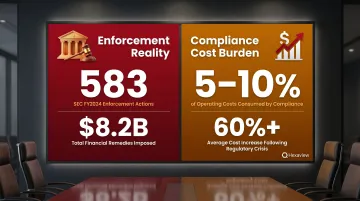
Hedge funds and asset managers operate under a web of overlapping regulatory obligations: Form ADV and Form PF filings for the SEC, best execution requirements under MiFID II and Reg NMS, AML/CFT programs, AIFMD disclosures, market abuse surveillance under MAR, FINRA conduct rules, and CFTC derivatives reporting. That's at least 10 distinct frameworks, many with conflicting requirements. The financial cost of falling short is steep: in fiscal year 2024, the SEC filed 583 enforcement actions and obtained $8.2 billion in financial remedies, the highest total in the agency's history.
Yet compliance teams remain stretched thin. While hedge funds spend between 5% and upwards of 10% of operating costs on compliance, manual monitoring of trade activity, investor communications, and portfolio data can't match the real-time oversight regulators expect. Periodic audits and static rule sets no longer suffice when enforcement actions target firms' inability to demonstrate continuous surveillance and proactive risk detection.
This article explains how AI compliance agents are reshaping regulatory oversight for hedge funds and asset managers—covering how they work, where they deliver the most value, the tangible benefits they provide, and the critical implementation challenges firms must address before deployment.
Key Takeaways
- AI agents continuously monitor transactions, filings, and communications against regulatory rules in real time, shifting compliance teams from quarterly reviews to always-on surveillance
- Core use cases include trade surveillance for market abuse, Form PF/ADV filing preparation, AML/KYC screening, best execution monitoring, and investor disclosure review
- Continuous monitoring cuts audit prep time, reduces operational costs, and scales compliance coverage without proportional headcount growth
- Key challenges: model explainability for regulatory scrutiny, data quality dependencies, false positive management, and mandatory human oversight for high-risk decisions
- Effective implementation means aligning agent capabilities to specific compliance workflows — not deploying generic AI on regulated processes
The Compliance Burden Facing Hedge Funds and Asset Managers Today
Asset managers face a unique compliance pressure point: smaller teams managing disproportionate regulatory volume. Unlike traditional banks with dedicated compliance departments scaled to asset size, hedge funds and RIAs typically operate with lean compliance functions covering investment adviser regulations, trading rules, investor-facing requirements, and now—following FinCEN's September 2024 final rule—formal AML/CFT programs with SAR filing obligations by January 1, 2028.
Hedge funds spend between 5% and upwards of 10% of operating costs on compliance technology, headcount, and strategy. Smaller fund managers bear the heaviest burden relative to AUM. Across broader financial services, Deloitte reports compliance operating costs have risen over 60% compared to pre-financial-crisis levels, consuming nearly all discretionary funding available to firms over an eight-year period.
These cost pressures are compounded by a fundamental scalability problem: rule books are static while regulations evolve across multiple jurisdictions simultaneously. Manual processes widen the gap further:
- Monitoring trade activity for market abuse patterns
- Reconciling portfolio disclosures against mandates each quarter
- Screening investors against sanctions lists periodically
A violation can occur on Monday and go undetected until the next monthly review — long after regulators expect firms to have identified and escalated it.
Regulators are tightening scrutiny in response. The SEC's 2025 Examination Priorities explicitly target investment advisers' fiduciary duties, Form PF compliance, and firms' use of AI for fraud prevention, AML, and trading. ESMA issued guidance in May 2024 on AI use in investment services, emphasizing MiFID II organizational requirements and client best interest obligations.
The enforcement landscape reflects this shift. The SEC's March 2024 actions against Delphia and Global Predictions for "AI-washing" — making false claims about AI capabilities — marked the first Marketing Rule enforcement in the AI context. Both compliance processes and the tools firms use to manage them now face regulatory examination.
What Is an AI Compliance Agent and How Does It Differ from Traditional Tools
An AI compliance agent is an autonomous software system that connects to regulated data sources—trade management systems, CRM platforms, email archives, investor portals, regulatory feeds—applies rule-based and machine learning logic to monitor activity, detects anomalies or violations, generates documentation, and triggers alerts or escalations without waiting for a human to initiate the process.
The distinction from legacy GRC platforms is operational. Traditional compliance tools require manual data uploads, rely on static rule sets defined during implementation, and produce retrospective reports.
An agent operates continuously. It adapts to changing rules via regulatory feed integration, cross-references activity against multiple frameworks simultaneously, and takes proactive action:
- Flags suspicious trade patterns in real time
- Escalates Form PF discrepancies before filing deadlines
- Routes investor communications to legal review when they contain undisclosed material information
Human oversight remains mandatory. AI compliance agents are not fully autonomous decision-makers. High-risk outputs—Suspicious Activity Reports (SARs), regulatory filings, enforcement escalations—require compliance officer review and authorization. The agent surfaces decisions, provides supporting evidence, and documents the rationale, but final responsibility rests with qualified professionals. This makes the agent a productivity amplifier for—not a replacement of— compliance teams.
How AI Compliance Agents Work: The Architecture Behind the Automation
Data Ingestion and Connectivity
Agents connect to trade management systems, OMS/EMS platforms, CRM tools, email archives, investor portals, and external regulatory feeds to pull structured and unstructured data continuously. This breadth of connectivity enables real-time compliance monitoring across complex fund environments where data lives in siloed systems: portfolio holdings in one platform, investor communications in another, and trade executions in a third.
Policy Inference and Rule Mapping
Using natural language processing and regulatory data models, agents map ingested data against current regulatory frameworks. For asset managers, this means applying obligations across multiple dimensions:
- Trade data cross-referenced against MiFID II best execution requirements
- Portfolio activity checked against investment mandate restrictions
- Investor communications screened against FCA market abuse surveillance expectations
The agent interprets each regulatory obligation and applies it to specific transactions, positions, or disclosures.
Violation Detection and Anomaly Scoring
Agents use machine learning models and rule-based logic to score activity against compliance thresholds. Common detection scenarios include:
- Flagging trades that may constitute front-running based on restricted employee lists and timing patterns
- Identifying Form PF discrepancies where disclosed AUM doesn't reconcile with custodian data
- Detecting investor communications that reference performance data inconsistent with fund fact sheets
Audit Trail and Documentation Generation
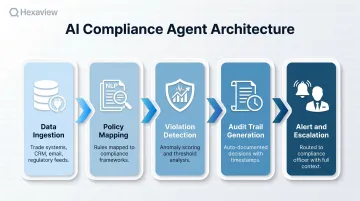
Every decision, flag, and escalation is logged automatically with timestamps, source data references, and decision rationale. The result is structured, traceable evidence that regulators expect during examinations — eliminating the need to reconstruct activity history when the SEC issues a document request.
Alert, Escalation, and Remediation
When a violation or risk threshold is crossed, the agent routes the issue to the appropriate compliance officer or legal team with full context. For asset managers, this context includes:
- Draft SAR narratives with supporting transaction details
- Pre-populated regulatory filing sections ready for attorney or CCO review
- Flagged portfolio positions requiring remediation before they become reportable incidents
Key Use Cases: AI Agents for Hedge Fund and Asset Management Compliance
Trade Surveillance and Market Abuse Monitoring
AI agents continuously scan trading activity for patterns indicating potential market abuse—insider trading, layering, spoofing, and front-running—cross-referencing employee restricted lists, news feeds, and historical trade patterns. Under EU MAR Article 16, firms must have "effective arrangements, systems and procedures" to detect and report suspicious transactions "without delay." For firms of any meaningful scale, this effectively mandates automated surveillance.
Real-time detection replaces end-of-day batch reviews. When an employee executes a trade in a security on their restricted list, or when order patterns suggest layering behavior, the agent flags it immediately — giving compliance teams time to investigate before a reportable incident occurs.
Bloomberg identifies seven common market abuse scenarios monitored through trade surveillance:
- Spoofing and layering
- Wash trading
- Insider trading and front-running
- Ramping/marking the close
- Cross-venue manipulation
Regulatory Filing Preparation and Monitoring (Form PF, Form ADV, AIFMD Annex IV)
Agents extract, validate, and compile data from across fund systems to prepare regulatory filings, cross-checking AUM figures, investor classifications, and strategy disclosures for accuracy before submission. The SEC's February 2024 amendments to Form PF (compliance date October 1, 2026) add new requirements for large hedge fund advisers including counterparty exposure reporting, increasing filing complexity.
This reduces the quarterly filing crunch. Instead of compliance teams spending weeks manually gathering data, reconciling discrepancies, and hoping nothing was missed, the agent continuously validates source data, flags inconsistencies as they occur, and auto-populates draft filings. Compliance officers review and authorize rather than assemble from scratch.
AML, KYC, and Investor Onboarding Compliance
AI agents automate several critical onboarding and ongoing monitoring tasks:
- Screen new and existing investors against sanctions lists (OFAC, UN) and PEP databases
- Flag discrepancies in investor documentation and adverse media
- Trigger re-KYC workflows when risk profiles change
- Maintain audit trails required under FATF and local AML regulations
With FinCEN's investment adviser AML rule requiring RIAs and ERAs to establish formal AML programs by January 1, 2028, this automation becomes essential. Traditional AML systems generate 90-95% false positive rates, creating massive alert fatigue. AI agents that reduce false positives while maintaining coverage deliver measurable ROI — fewer wasted analyst hours and stronger regulatory defensibility.
Best Execution Monitoring and MiFID II/Reg NMS Compliance
Agents analyze execution quality across brokers and venues, comparing achieved prices against benchmarks and flagging instances where best execution obligations may not have been met. This automates the evidence collection required for best execution reports under SEC fiduciary duties and MiFID II transaction reporting.
The agent continuously monitors trade executions and identifies outliers where prices deviate significantly from VWAP or other benchmarks. It documents that analysis automatically, giving compliance teams structured evidence ready for regulatory examinations.
Investor Reporting and Disclosure Compliance
Agents review investor communications, fund fact sheets, and performance reports for accuracy, consistency with the fund's mandate, and alignment with marketing regulations. The SEC's March 2024 AI-washing enforcement actions against Delphia and Global Predictions were brought under the Marketing Rule for untrue statements about AI capabilities.
Before reports go out, agents catch discrepancies: strategy descriptions that don't match actual portfolio activity, performance data inconsistent across investor communications, or marketing claims unsupported by underlying data.
Building these workflows requires more than AI familiarity — it requires understanding how regulators examine evidence, how fund data flows across systems, and where automation breaks down under audit. Hexaview's capital markets practice, with clients including LPL Financial and Addepar, brings that operational knowledge to each implementation.
Benefits of Deploying AI Agents for Regulatory Compliance
Continuous Real-Time Monitoring Replaces Reactive Point-in-Time Reviews
The most significant operational shift: moving from quarterly or monthly compliance reviews to 24/7 automated monitoring. Agents detect and surface potential violations as they happen, giving compliance teams time to respond before a regulatory incident occurs.
FinCEN requires SAR filing within 30 calendar days of detecting facts that may constitute a basis for filing—extending to 60 days if no suspect is identified. Firms using manual monthly reviews may not detect suspicious activity until weeks after it occurred, leaving minimal time for investigation before the filing deadline. Real-time agent monitoring eliminates this gap.
Dramatically Reduced Compliance Operational Costs and Time Burden
Automating repetitive tasks—screening, data extraction, filing preparation, documentation—frees compliance staff to focus on judgment-intensive work. LexisNexis reports that 79% of mid-to-large financial institutions saw increases in KYC software technology costs, while 83% saw increases in screening alerts. The manual compliance burden keeps growing—and it's not sustainable.
AI-powered workflows directly address this. Hexaview has documented 20,000+ man hours saved in analysis and a 97% improvement in data accuracy across financial services engagements—outcomes that become possible when compliance teams replace manual data gathering with automated evidence generation.
Audit Readiness and Regulatory Examination Confidence
Agents automatically generate complete, timestamped audit trails that satisfy SEC, FCA, and ESMA examination requirements. Compliance teams no longer scramble to reconstruct evidence when a regulator requests documentation—all decisions and data access are logged by default.
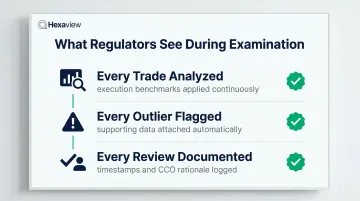
When the SEC requests documentation of how a firm monitored best execution over the past 18 months, the agent-generated audit trail provides complete visibility:
- Every trade analyzed against execution benchmarks
- Every outlier flagged with supporting data
- Every compliance officer review documented with timestamps and decision rationale
Scalable Compliance Coverage Without Proportional Headcount Growth
AI agents allow a fund to expand regulatory coverage—adding new jurisdictions, new regulatory obligations, or new fund strategies—without requiring a linear increase in compliance staff. For mid-market asset managers running multi-strategy or multi-geography portfolios, compliance complexity routinely outpaces revenue growth. Agents close that gap without adding headcount.
A fund expanding from US-only operations to include UCITS and AIFMD obligations would traditionally need to hire additional compliance expertise for each jurisdiction. With agents, the same core compliance team can scale coverage by configuring the agent to monitor additional rule sets and flag jurisdiction-specific violations.
Challenges, Risks, and How to Get Started
Key Implementation Risks to Address
Model Explainability: Regulators expect firms to explain AI-generated decisions, not just outputs. FINRA requires explainability for compliance, audit, and risk personnel, including written summaries of key input factors and output rationale. "Ex-post rationalization"—finding correlations lacking causality—is explicitly discouraged.
Data Quality Dependency: Agents are only as accurate as the data they ingest. Poor data governance undermines compliance value. If trade data is delayed, investor records are incomplete, or portfolio positions aren't reconciled daily, the agent will flag false violations or miss real ones.
False Positive Management: Over-alerting leads to alert fatigue and undermines trust. Traditional AML systems generate 90-95% false positive rates, with sanctions screening reaching 99.5%. AI agents should reduce false positives, but initial tuning is critical—firms must balance sensitivity (catching all real violations) with precision (minimizing false alarms).
Human-in-the-Loop Requirement: Human oversight is non-negotiable for high-risk decisions. SARs, regulatory filings, and enforcement escalations must be reviewed and authorized by qualified compliance professionals, not auto-submitted by agents.
Building the Right Foundation Before Deploying Agents
Successful implementation starts with mapping regulatory obligations to specific data sources and workflows before selecting or building any agent. Firms should prioritize high-risk, high-volume compliance workflows for initial deployment and expand from there—trade surveillance, AML screening, and regulatory filing preparation are the right starting points.
Critical success factor: Work with technology partners who combine deep capital markets regulatory knowledge with AI engineering expertise, not just general AI vendors. A partner that understands Form PF reporting requirements, MAR surveillance obligations, and FinCEN SAR standards will build agents that meet regulatory expectations from day one.
For firms weighing the build-vs-partner decision, Hexaview Technologies brings over 10 years of capital markets and wealth management experience alongside SOC 2 Type 2 certification. Their work spans AI engineering, regulatory data workflows, and financial services compliance—the combination that actually matters when agents need to hold up under regulatory scrutiny.
Staying Ahead of Regulatory Requirements for AI Systems Themselves
Regulators are scrutinizing the AI systems firms use for compliance. The EU AI Act classifies high-risk AI systems as requiring documentation, ongoing monitoring, and human oversight—with full enforcement by August 2, 2026. The SEC's 2025 priorities examine how firms use AI to "optimize efficiencies," while FCA guidance increasingly expects firms to demonstrate that AI-assisted compliance tools are auditable and governed.
Firms should ensure their AI compliance infrastructure meets the same governance standards it is designed to enforce. That means:
- Documented model risk management processes
- Explainability records available for regulatory scrutiny
- Defined human oversight protocols for high-risk outputs
- Ongoing performance monitoring and audit trails
Frequently Asked Questions
What is an AI compliance agent?
An AI compliance agent is autonomous software that continuously monitors enterprise data against regulatory rules, flags violations, and generates documentation without manual intervention. Unlike traditional tools that produce retrospective reports, agents adapt to regulatory changes via live feeds and operate around the clock.
How is AI used in regulatory compliance?
AI handles transaction monitoring, investor screening (AML/KYC), regulatory filing preparation, and audit trail generation. It enforces internal policies by validating data across systems and flagging anomalies automatically. Human reviewers retain authority over final decisions, such as SAR filings.
What is the typical AI agent workflow?
A standard compliance agent pipeline runs five stages:
- Ingest data from trade platforms, CRM, and email systems
- Map inputs to regulatory rules using NLP frameworks
- Score anomalies and detect violations via ML models
- Log decisions with timestamps and reasoning for audit trails
- Escalate alerts to human reviewers for final determination
How do you audit AI agent activity?
Auditing requires complete decision chain logging (every input, rule applied, output, and escalation), human-readable audit trails translated from technical logs, and regular quality reviews by compliance teams. Regulators increasingly expect this under frameworks like the EU AI Act and FINRA AI guidance.
What are the compliance requirements for AI agents used in financial services?
Financial services AI agents must satisfy several regulatory expectations:
- Explainability: Automated decisions must be interpretable and documented
- Governance: Firms need formal frameworks covering model oversight and accountability
- Human review: High-risk outputs require human sign-off before action
- Data controls: Access restrictions and data protection measures are mandatory
- Regulatory alignment: SEC, FCA, FINRA, EU AI Act, and Federal Reserve SR 11-7 all apply
How is AI used in compliance training?
AI personalizes learning modules based on role and regulatory exposure, automates tracking of mandatory training completion, and flags employees who are overdue for required certifications. Agents can also identify knowledge gaps based on compliance incidents and recommend targeted training interventions.