Introduction
FinTech and wealth management firms face mounting strategic pressure from three converging forces: rising client expectations for personalized, tax-optimized advice; intensifying regulatory complexity across AML, credit, and advisory functions; and a widening competitive gap between AI adopters and laggards. BCG research shows that AI "future-built" firms now achieve 5x the revenue increases and 3x the cost reductions of their peers, while 60% of organizations remain in the lagging category. Inaction is no longer a missed opportunity—it's a strategic risk.
This guide helps financial services leaders understand what AI consulting for FinTech and wealth management actually involves, what it can deliver, and how to approach strategy and implementation effectively. We'll cover high-impact use cases, consulting service components, implementation challenges unique to regulated financial services, and how to select the right partner.
TLDR:
- AI consulting addresses FinTech and wealth management's unique regulatory, data, and operational demands
- Fraud detection, AI credit scoring, and AML automation are proven use cases with measurable ROI (e.g., 42% of issuers saved $5M+ on fraud alone)
- Portfolio personalization and underbanked credit access represent the largest growth opportunities in wealth and lending AI
- Implementation success depends on data readiness, compliance-first design, and financial services domain experience
- Partner selection should prioritize SOC 2 Type 2 certification, sector expertise, and demonstrated outcomes over generic AI capability
What Is AI Consulting for FinTech and Wealth Management?
AI consulting in financial services is specialized advisory and implementation support that helps FinTech companies and wealth management firms adopt, deploy, and scale AI technologies. Unlike generic tech consulting, it addresses the unique regulatory, data, and operational demands of financial services—navigating FINRA, SEC, and GDPR requirements while delivering measurable business impact.
AI consulting differs from AI software development in critical ways:
- Aligns AI strategy with business goals, not just technical deliverables
- Selects appropriate models and infrastructure based on regulatory constraints and data availability
- Addresses compliance requirements around explainability, fairness, and auditability
- Builds governance frameworks and change management practices that sustain scale
The distinction matters because financial services AI implementations fail not from weak algorithms, but from organizational scaffolding gaps—misaligned incentives, inadequate data practices, and lack of AI-ready culture. Getting these foundations right is what separates a proof-of-concept from a production system that actually moves the business forward.
High-Impact AI Use Cases for FinTech and Wealth Management
FinTech Use Cases
Fraud Detection and Prevention
ML-powered fraud detection systems identify anomalous transaction patterns—card fraud, money laundering, market manipulation—in real time with higher accuracy and fewer false positives than rule-based systems.
Mastercard research finds that 42% of issuers saved more than $5M in fraud prevention over two years using AI, while 83% report significantly reduced false positives and customer churn. The Federal Reserve reports that non-credit-card fraud totaled $84B in 2024, with only $21B recovered—leaving $63B in net consumer losses.

AI-driven detection addresses this gap by analyzing hundreds of behavioral signals simultaneously, adapting to evolving fraud patterns without manual rule updates.
AI-Driven Credit Scoring
Traditional FICO-based credit models lock out 45 million Americans—26 million credit-invisible consumers plus 19 million with unscorable files. AI models trained on alternative data (transaction history, rent payments, utility bills, cash flow patterns) enable faster, fairer loan underwriting decisions.
Key advantages include:
- Scores 50M+ currently unscoreable consumers using alternative data signals
- Improves default prediction accuracy by modeling hundreds of variables, not a single score
- Cuts approval time from days to minutes through automated underwriting
- Reduces reliance on historical credit bias by weighting behavioral signals
The CFPB requires that AI credit models provide specific, accurate adverse action explanations. Building explainability into model architecture from the start — rather than retrofitting it — is where experienced AI consultants earn their value.
Regulatory Compliance and AML/KYC Automation
Financial crime compliance costs US and Canadian institutions $61B annually, yet only 4% of SARs warrant law enforcement follow-up. AI and NLP automate document verification, watchlist screening, and suspicious activity reporting—reducing costs and human error.
AI-driven AML systems deliver:
- Analyst workload drops by up to 80% as ML models prioritize high-risk alerts automatically
- Graph analytics surface complex laundering networks that rule-based systems miss entirely
- Real-time screening replaces periodic batch reviews, closing the gap fraud exploits
- Automated documentation creates audit-ready trails for regulatory reporting
For compliance teams stretched thin across an expanding regulatory surface, AI shifts the work from manual alert processing to higher-judgment investigation.
Wealth Management Use Cases
Where FinTech AI largely targets risk and compliance, wealth management applications focus on personalization and advisor productivity. The use cases below reflect where firms are seeing the clearest ROI.
Portfolio Optimization and AI-Driven Investment Analytics
Machine learning identifies non-linear market patterns, supports algorithmic rebalancing, and enables hyper-personalized portfolio recommendations scaled across large client bases. Cerulli research shows that 80% of affluent investors demand account customization, while 82% of managed account sponsors prioritize tax management capabilities.
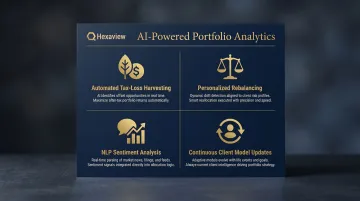
AI-powered portfolio analytics enable:
- Automated tax-loss harvesting across thousands of accounts simultaneously
- Rebalancing models that factor in each client's liquidity needs, tax status, and risk tolerance
- NLP processing of news, earnings calls, and sentiment data for alpha generation
- Individual client models updated continuously — without adding to advisor workload
Robo-Advisory and Client-Facing AI Tools
AI-powered financial planning assistants deliver personalized advice across hundreds of client accounts, automating routine interactions like portfolio reviews and goal-tracking updates. Major platforms including Schwab ($89.5B AUM), Betterment ($56.4B), and Wealthfront ($42.9B) demonstrate proven market acceptance.
Robo-advisory tools allow firms to:
- Profitably serve mass-affluent segments by lowering minimum account thresholds
- Free advisors from routine questions, redirecting time to high-value client relationships
- Eliminate advisor variability through algorithm-driven recommendation consistency
- Update individual client models continuously as market conditions shift
Automated Reporting and Data Aggregation
AI eliminates manual reconciliation across custodians and platforms, accelerates statement generation, and improves data accuracy. In a documented wealth management engagement, automated data aggregation delivered a 97% rise in data accuracy and 20,000+ man hours saved in analysis—concrete results that reflect what firms routinely sacrifice to manual processes.
Benefits include:
- Unified client views across fragmented custodial feeds (LPL, Fidelity, ORION, others)
- Automated reconciliation that detects discrepancies requiring human review
- Accelerated reporting cycles from weeks to days
- Improved advisor productivity through data quality and accessibility
What AI Consulting Services Actually Include
AI Strategy and Roadmap Development
Strong consulting engagements begin with structured AI readiness assessments: mapping current data infrastructure, identifying high-value use cases, defining KPIs, and building phased implementation roadmaps aligned to regulatory requirements and business goals. The output is domain-specific prioritization, not generic technology adoption advice.
AI readiness assessments typically cover:
- Audits of data quality, accessibility, and integration readiness across existing sources
- ROI modeling across fraud detection, credit, advisory, and compliance use cases
- Regulatory mapping covering FINRA, SEC, GDPR, and applicable state-level requirements
- Organizational readiness — executive sponsorship, internal talent gaps, and change capacity
From there, consultants define the technology stack: build vs. buy decisions, cloud infrastructure choices such as AWS, and integration paths with CRMs, portfolio management platforms, or core banking systems.
AI Model Development and Customization
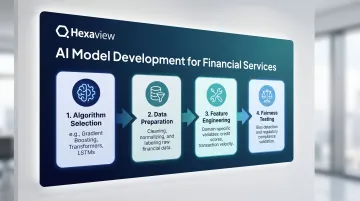
Model development involves selecting appropriate algorithms, preparing and labeling financial data, training models on domain-specific datasets, and incorporating interpretability and fairness measures critical for compliance.
Key development activities include:
- Algorithm selection: Matching model types (gradient boosting for credit risk, transformers for NLP, LSTMs for time series) to use cases
- Data preparation: Cleaning, normalizing, and labeling transaction records, custodian feeds, or alternative data sources
- Feature engineering: Creating domain-specific variables (volatility measures, transaction velocity, relationship graphs)
- Fairness testing: Bias detection and mitigation for protected classes in lending and advisory contexts
Financial AI models require ongoing retraining as market conditions shift. Consultants build automated pipelines to detect model drift — tracking prediction accuracy, feature importance changes, and data distribution shifts that trigger retraining cycles.
Deployment, Integration, and Change Management
Deployment integrates AI outputs into existing workflows: surfacing risk scores inside CRMs, embedding compliance flags in document review tools, building user interfaces that make AI outputs actionable. The goal is minimal disruption during rollout.
Integration typically includes:
- API development connecting AI models to portfolio management systems
- Dashboard design presenting model outputs to compliance teams or advisors
- Workflow automation routing flagged transactions or accounts for human review
- Testing and validation ensuring accuracy before production release
Change management and staff enablement determine whether adoption actually sticks. This means training teams to interpret AI outputs confidently, establishing governance frameworks — who approves model changes, retraining cadence, escalation paths for edge cases — and building internal champions to sustain adoption beyond the initial launch.
Navigating AI Implementation Challenges in Financial Services
Data Quality and Availability
Gartner research finds that 63% of organizations lack AI-ready data practices, and predicts 60% of AI projects unsupported by AI-ready data will be abandoned through 2026. Financial AI systems require large volumes of clean, consistent, labeled data across disparate sources—market data, CRM, custodian feeds.
Consultants establish ETL pipelines, data governance frameworks, and integration layers to unify siloed data before model training begins. That foundational work—not algorithm selection—determines whether a project succeeds or stalls.
Regulatory and Compliance Requirements
Financial firms operate under strict regimes—SEC, FINRA, GDPR, AML/BSA. AI models used in credit, advisory, or trading decisions must be explainable, auditable, and bias-tested. The EU AI Act imposes penalties up to 6% of global annual turnover for non-compliance with high-risk AI system requirements.
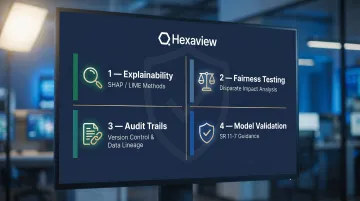
Experienced consultants embed compliance checkpoints throughout model design:
- Explainability: SHAP values or LIME techniques showing how models reach decisions
- Fairness testing: Disparate impact analysis for protected classes in lending models
- Audit trails: Version control, data lineage, and decision logs satisfying regulatory examination
- Model validation: Independent review processes meeting Federal Reserve SR 11-7 guidance
Hexaview holds SOC 2 Type 2 certification—meaning these compliance disciplines are embedded in delivery practice, not bolted on at project close.
Legacy System Integration
Accenture finds that 58% of North American banks struggle with outdated IT systems, with up to 70% of IT budgets consumed by legacy maintenance. Many core systems were not built for API-driven AI integration.
Consultants architect middleware, microservices layers, or cloud-native bridges that allow AI to communicate with legacy infrastructure without requiring full stack replacement. This pragmatic approach delivers AI value while preserving existing investments.
AI Talent Gap
Infrastructure alone doesn't close the execution gap. World Economic Forum data shows 73% of financial services leaders cite AI talent scarcity as a critical barrier. Engaging an external consulting partner fills that gap immediately—providing data scientists, ML engineers, and compliance-aware AI architects—while supporting internal upskilling so teams can sustain deployed models long-term.
Domain expertise matters more than raw technical skill here. Goldman Sachs research finds that finance-familiar AI specialists deliver successful outcomes 79% faster than generalists.
How to Choose the Right AI Consulting Partner for FinTech and Wealth Management
Financial Domain Knowledge Comes First
The right consulting partner already understands the regulatory landscape — FINRA, SEC, GDPR — along with the data architecture of financial platforms (custodial feeds, FIX protocol, portfolio management systems) and the distinct priorities of wealth managers versus FinTech operators. Your budget should fund execution, not onboarding them to financial services basics.
Security and Compliance Credentials You Should Verify
When working with AUM data, PII, or transaction records, institutional-grade data handling is non-negotiable. Look for:
- SOC 2 Type 2 certification confirming ongoing security controls
- ISO 27001 covering information security management systems
- Cloud security partnerships such as AWS Select Tier, demonstrating vetted infrastructure practices
Outcomes in Financial Contexts, Not Just Methodology Decks
Ask any prospective partner for specific results in financial services — measurable improvements in data accuracy, processing time, cost reduction, or risk management. The stakes are real: Deloitte finds only 38% of AI projects in finance meet ROI expectations, while BCG reports that 70% of AI implementation challenges stem from people and processes, not algorithms. That gap is exactly where a seasoned partner earns its value.
Why FinTech and Wealth Management Firms Choose Hexaview
10+ Years of Domain Expertise in Capital Markets
Hexaview brings over 10 years of focused experience in capital markets and wealth management, recognized through WealthTech 100 (2023) and DATATECH50 (2025) honors. Major client relationships including LPL Financial and Addepar demonstrate longevity and real-world credibility.
### End-to-End Service Capability
FinTech and wealth management firms can work with a single partner from roadmap through production — no vendor juggling required. Hexaview's service range covers:
- AI strategy and data engineering
- Agentforce-powered workflow automation
- Salesforce integration as a Certified Ridge Consulting Partner
- AWS-backed cloud deployment and infrastructure
Built-In Compliance for Regulated Financial Institutions
SOC 2 Type 2 certification and an ISO-certified Information Security Management System directly address the compliance and data protection requirements that regulated financial institutions prioritize. Combined with AWS Select Tier Service Partner status, Hexaview provides the security and infrastructure foundation required for enterprise-grade AI deployments.
Frequently Asked Questions
What AI services are created for banks?
Core AI services for banks include fraud detection, credit risk modeling, AML/KYC automation, AI-powered customer service chatbots, and predictive analytics for product personalization and churn prevention. Most implementations focus on regulatory compliance and operational efficiency.
How much does an AI consultant cost?
Costs vary widely based on scope, engagement model (project-based versus retainer), and firm size. Pricing ranges from focused strategy engagements to full-scale multi-month implementations. Evaluate total value by weighing time saved, risk reduced, and revenue unlocked against the engagement fee — not just the hourly rate.
What is the best AI for banking and finance?
The right AI depends entirely on the use case. ML models excel at fraud detection, NLP handles document processing, LLMs power client-facing assistants, and deep learning drives trading signal analysis. A strong consulting partner evaluates your specific workflows before recommending any technology stack.
How long does AI implementation take in financial services?
Timelines vary by complexity. Targeted use cases like fraud detection or chatbot deployment may show results in 6–12 weeks, while enterprise-wide transformation initiatives typically span 6–18 months. Phased rollouts work best because they let teams validate results and adjust before scaling firm-wide.
How do I know if my FinTech or wealth management firm is ready for AI consulting?
Key readiness signals include access to structured data, a defined business problem AI can address, executive sponsorship, and willingness to invest in change management. Even firms without mature data infrastructure can begin with a readiness assessment and roadmap engagement.