Introduction
Wealth management and asset management firms face relentless pressure to modernize. Competitors deploy AI across portfolio analytics, client reporting, compliance monitoring, and client engagement—yet most initiatives stall before reaching production. The gap between pilot and production isn't just costly. Firms that close it pull ahead on AUM growth, operational efficiency, and client retention. Those that don't cede ground they won't recover.
The obstacle isn't investment. According to EY's 2025 survey, 95% of wealth and asset management firms have already scaled GenAI to multiple use cases, with 75% budgeting over $11 million for GenAI initiatives.
Yet BCG research finds only 5% of firms are actually "future-built"—generating measurable value from AI. The rest struggle with fragmented data, misaligned strategy, and compliance roadblocks that no budget alone can fix.
That gap is what this article addresses. It covers the AI use cases with real traction in wealth and asset management, what separates a qualified consulting partner from a generalist, and how firms move from endless experimentation to production—without compromising compliance or data integrity.
Key Takeaways
- AI consulting partners move wealth and asset management firms from experiments to production systems delivering measurable ROI
- Core use cases: portfolio risk analytics, automated client reporting, regulatory compliance automation, and structured client onboarding automation
- The right partner brings capital markets domain expertise, SOC 2 compliance readiness, and a proven record of shipping AI systems that hold up in production
- Biggest risk isn't failed AI models—it's misaligned strategy, fragmented data, and missing governance frameworks
- Firms working with qualified partners have achieved a 97% rise in data accuracy and recovered 20,000+ analyst hours annually through AI-driven workflows
Why Wealth Management and Asset Management Firms Need an AI Consulting Partner Now
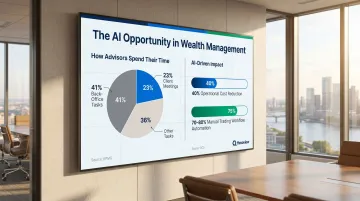
Wealth management and asset management are drowning in manual work. KPMG's 2025 research shows advisors spend 41% of their time on back-office tasks and only 23% meeting clients. Meanwhile, data scientists spend 80% of their time on manual data preparation rather than analysis, according to J.P. Morgan Fusion.
This represents a massive opportunity cost. BCG projects that AI-enabled portfolio management can reduce operational costs by 40% across the value chain, while 70-80% of manual trading workflows can be automated.
The Generic AI Consulting Problem
Generic AI consulting fails in financial services because this industry operates under strict regulatory constraints: SEC rules, FINRA requirements, and fiduciary standards that demand high-precision data outputs and rigorous data governance. A consulting partner without deep capital markets knowledge risks building solutions that pass demos but fail compliance review or create audit exposure.
The Cost of Waiting
EY data confirms 95% of firms have adopted GenAI across multiple use cases, yet 66% of early adopters would revise their initial strategies if starting over. That gap signals a pattern: first attempts with generic tools or partners routinely fell short. Firms that chose the right partners from the start are already seeing measurable results:
- Compressed reporting timelines
- Reduced operational costs
- Personalized client experiences delivered at scale
BCG research shows "future-built" companies achieve 5x the revenue increases and 3x the cost reductions of laggards. They dedicate up to 64% more of their IT budget to AI — and the competitive gap is widening fast.
Key AI Use Cases Transforming Wealth and Asset Management
Portfolio Risk Analytics and Scenario Modeling
AI enables firms to run multi-factor risk models across complex portfolios in near real-time, replacing time-consuming Excel-based analysis. Machine learning models detect concentration risk, tail risk, and correlation shifts faster than traditional methods.
Key capabilities driving adoption:
- Detects concentration risk, tail risk, and correlation shifts in near real-time
- Automates 70-80% of standard execution flow—prechecks, order management, fill monitoring
- Frees analysts from routine tasks to focus on higher-value judgment calls
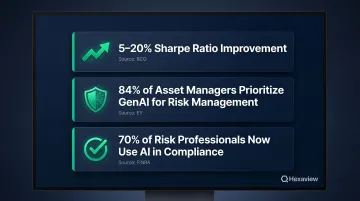
BCG estimates a potential 5-20% improvement in Sharpe ratio for managers deploying AI across investment processes. EY's survey shows 84% of asset managers prioritize GenAI for risk management automation, and FINRA reports that 70% of risk and technology professionals now use AI in risk and compliance functions.
Automated Client Reporting and AUM Analytics
AI-powered data pipelines automate the generation of customized client performance reports, reducing turnaround time from days to hours while improving accuracy. Generative AI can save 25-50% of employee time in middle- and back-office functions, according to Morgan Stanley and Oliver Wyman research.
Hexaview has delivered a documented 97% improvement in data accuracy for clients in this space, with over 20,000 analyst hours saved through automation. KPMG case studies show that AI assistants analyzing advisor profiles and generating personalized meeting agendas can reduce preparation time by up to 50%—saving 20,000 hours annually at top-10 investment managers.
Regulatory Compliance and Audit Automation
AI monitors transactions, flags anomalies, and auto-generates audit trails for regulatory submissions—reducing compliance team burden and minimizing human error risk. This is critical for firms subject to SEC reporting requirements or operating across multiple jurisdictions.
The numbers back this up:
- KPMG estimates agentic AI reduces manual compliance monitoring costs by 35-45%
- EY research finds 30% of Nordic banks have deployed AI in transaction monitoring, with 75% planning further investment
- FINRA notes AI surveillance tools now monitor text, voice, and video to reduce false positives in trade surveillance
Client Onboarding and KYC Intelligence
AI accelerates Know Your Customer workflows by extracting and validating data from documents, cross-referencing watchlists, and auto-populating CRM fields—reducing onboarding cycle time and improving compliance accuracy.
KPMG research shows agentic AI in onboarding saves 30-40% in manual processing and compliance check costs—and can accelerate client onboarding by 50%, with the potential to double annual client additions. McKinsey's analysis of KYC straight-through processing shows AI cuts end-to-end cycle time significantly, particularly for firms managing high onboarding volumes.
Emerging Use Cases Worth Watching
AI-powered advisor copilots are moving from pilot to production at forward-thinking firms. Morgan Stanley's AI assistant, fully rolled out in September 2023, has achieved 98% adoption among Financial Advisor teams. Their "AI @ Morgan Stanley Debrief"—an AI-powered meeting note generator integrated with Salesforce—launched in June 2024.
Morningstar deployed Microsoft Copilot across its wealth advisory platform, with Copilot often being the first AI solution advisors and wealth firms adopt.
Agentic workflows that monitor market signals and trigger portfolio rebalancing alerts are also emerging, with firms like OneVest launching "Agentic Wealth OS" with real-time AI data access and action capabilities.
What Separates a Great AI Consulting Partner in Financial Services
Deep Domain Expertise Over Generic AI Capability
The critical differentiator is a partner who understands the specific workflows, data structures, and regulatory context of wealth and asset management. Ask: can they speak the language of AUM, NAV, GIPS compliance, and custodian data reconciliation?
Hexaview brings over 10 years of domain experience in capital markets and wealth management, recognized in the WealthTech 100 (2023) and DATATECH50 (2025). Notable clients include LPL Financial and Addepar—evidence of enterprise-grade delivery in this specific vertical.
Security and Compliance Posture
In financial services, AI consulting partners must meet enterprise-grade security standards. Look for SOC 2 Type 2 certification—ensuring data handling practices have been audited over a specified period (typically 6-12 months). The SOC 2 framework covers security, availability, processing integrity, confidentiality, and privacy.
FINRA Regulatory Notice 24-09 addresses member firms' obligations when using generative AI and large language models. Member firms must:
- Evaluate GenAI tools from third-party vendors before deployment
- Request contract amendments prohibiting sensitive data ingestion into open-source models
- Establish enterprise-level supervision over all AI-assisted workflows
Hexaview holds SOC 2 Type 2 and ISO certifications, making it a credible choice for firms with strict data governance requirements. The company is also an AWS Select Tier Service Partner.
Production-Grade Delivery Track Record
Distinguish between partners who can build polished pilots and those who have successfully taken AI systems through QA, compliance review, and enterprise deployment. Ask partners for examples of systems currently running in production at comparable firms—not just proof-of-concept slide decks.
Approximately 95% of enterprise GenAI pilots are failing to achieve rapid revenue acceleration, according to MIT research. The primary cause isn't regulation or model performance—it's flawed enterprise integration.
Full-Stack Capability
Wealth management AI solutions require strong foundations in data pipeline architecture, ML model development, CRM integration (e.g., Salesforce), and business process automation. A partner who only handles model development without owning the surrounding infrastructure creates integration gaps.
Hexaview's full-stack offering covers:
- AI Engineering and Data Science consulting
- Salesforce/Agentforce-powered workflow automation with built-in guardrails
- Business process automation and data visualization solutions
All services are delivered under SOC 2 Type 2 and ISO-certified security standards.
Ongoing Governance and Model Monitoring
Without active monitoring, AI models degrade as market conditions shift—producing unreliable outputs that can go undetected until they create compliance or business risk. Look for partners who commit to post-deployment monitoring, model retraining schedules, and governance frameworks that satisfy internal risk and audit functions.
Version tracking, documentation, and audit trails are non-negotiable in regulated environments.
From AI Pilot to Production: Navigating the Transition in Regulated Environments
Why the Pilot-to-Production Gap Is Especially Wide in Financial Services
Regulatory review cycles, data access controls, IT infrastructure constraints, and change management within compliance-heavy teams all create friction that generic AI consultants underestimate. Gartner predicts that through 2026, organizations will abandon 60% of AI projects unsupported by AI-ready data.
EY's survey reveals that 86% of wealth and asset management firms were surprised by regulatory and compliance complexities during GenAI deployment. 88% of asset managers cite regulatory and compliance requirements as the greatest hurdle to adoption.
What a Structured AI Deployment Roadmap Looks Like
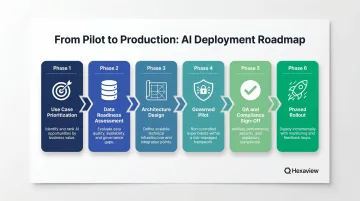
A qualified roadmap starts with use case prioritization tied to measurable business outcomes (e.g., reduce reporting cycle from 5 days to 1 day), followed by data readiness assessment, architecture design, a governed pilot, compliance sign-off, and phased production rollout.
Key phases include:
- Use case prioritization aligned to business impact and feasibility
- Data readiness assessment evaluating source quality and access controls
- Architecture design for scalability and security
- Governed pilot with compliance and risk team involvement
- QA and compliance sign-off before production release
- Phased rollout with monitoring and feedback loops
Data Fragmentation as the Hidden Obstacle
That data readiness step on the roadmap is where most wealth management firms hit a wall. Client and portfolio data typically sits across custodians, proprietary systems, and legacy platforms — fragmented, inconsistent, and rarely audit-ready. The scale of the problem is significant:
- Only 25% of asset managers describe their data as "AI-ready"
- 70% cite legacy technology as the primary bottleneck
- Most firms manage 20–50+ distinct data sources, with storage requirements growing 2–3x every two years
A qualified AI consulting partner must design data unification layers that establish a clean, auditable foundation before any model is trained or deployed. In practice, this means consolidating data from custodians via SFTP and cloud storage, implementing custom transformation logic, and establishing data lineage and cataloging for compliance.
Change Management and Internal Adoption
Even well-built AI systems fail if advisors, analysts, or operations teams don't use them. A strong consulting partner embeds training, workflow redesign, and internal champion programs into the delivery plan from day one. Ongoing communication, structured user feedback loops, and iterative refinement as adoption scales are all part of the project scope — not optional extras added at the end.
How Hexaview Delivers AI Consulting for Wealth Management Enterprises
Hexaview is a specialized AI consulting partner with over 10 years of domain experience in capital markets and wealth management—recognized in the WealthTech 100 (2023) and DATATECH50 (2025). Clients including LPL Financial and Addepar reflect a track record of sustained delivery within this vertical.
The company's core service offering includes:
- ML model development and data pipeline engineering built for production environments
- Salesforce/Agentforce workflow automation with compliance guardrails built in
- Business process automation that reduces manual work and operational costs
- Real-time data visualization and reporting for faster portfolio-level decisions
All services are delivered under SOC 2 Type 2 and ISO-certified security standards, with Hexaview operating as an AWS Select Tier Service Partner. That compliance posture underpins every engagement — and translates into results wealth management teams can measure. Documented outcomes include:
- 97% improvement in data accuracy through automated data pipelines
- 20,000+ analyst hours saved annually via reporting automation
- Reduced operational costs through workflow optimization
- Faster decision-making cycles enabled by real-time analytics
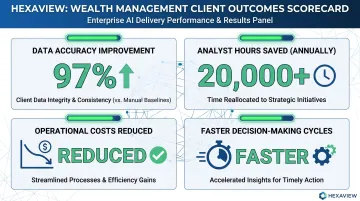
For wealth management firms evaluating AI consulting partners, these numbers reflect what a well-scoped, domain-specific engagement actually looks like in practice.
Frequently Asked Questions
What does an AI consulting partner do for wealth management firms?
An AI consulting partner helps wealth management firms identify high-value AI use cases, build production-grade systems integrated with existing workflows and data sources, and ensure those systems meet regulatory and compliance standards. This goes beyond strategy to hands-on engineering and deployment.
How is AI currently being used in asset management?
The main production use cases include portfolio risk analytics, automated reporting, regulatory compliance automation, client onboarding/KYC, and predictive analytics for investment decision support. Leading firms are also deploying advisor copilots and agentic workflows for portfolio rebalancing alerts.
What should wealth management firms look for when choosing an AI consulting partner?
Prioritize domain expertise in capital markets, SOC 2 Type 2 and ISO compliance credentials, a track record of production deployments (not just PoCs), full-stack capability from data engineering to CRM integration, and a commitment to post-deployment governance and model monitoring.
How long does it take to see ROI from an AI consulting engagement in financial services?
Well-scoped engagements with clear use cases and clean data foundations typically begin showing measurable ROI within 90-180 days. However, highly regulated or infrastructure-heavy environments may require longer timelines for compliance sign-off and phased rollout.
Is AI adoption safe and compliant for wealth management enterprises?
AI adoption is safe when the consulting partner holds enterprise-grade security certifications (SOC 2 Type 2, ISO), designs with audit trails and access controls built in, and follows a governance framework aligned with SEC/FINRA requirements — with data lineage, version tracking, and rollback capabilities included from the start.
What is the biggest reason AI projects fail in wealth management firms?
The most common causes are fragmented data infrastructure, lack of domain-aligned use case prioritization, and underestimating the compliance review cycle. The AI models themselves rarely fail — the surrounding data and governance foundation does. Firms that resolve these upstream before deployment see significantly faster, cleaner rollouts.