Introduction
Wealth managers and fund administrators are caught in a tightening vise. Assets under management hit $135 trillion globally in 2024, while 83% of advisors expect to charge under 1% for high-net-worth clients by 2026. At the same time, 50% of investment professionals would consider leaving the industry, creating a talent crisis just as regulatory demands intensify.
The operational pressure this creates is real. Intelligent automation (IA) is already transforming NAV calculations, reconciliation, compliance workflows, and investor reporting — giving firms a path to scale without proportionally scaling headcount.
This guide explains what IA means for wealth management and fund administration specifically, identifies the highest-ROI use cases, and shows how to avoid the implementation failures that plague 55% of automation initiatives.
TLDR:
- Intelligent automation combines RPA, AI, and ML to handle both structured tasks and complex, judgment-driven workflows
- Unique pressures — multi-custodian complexity, zero-error compliance, talent shortages — make IA critical for this sector
- Top use cases deliver 50%+ time savings in reconciliation, NAV processing, and client onboarding
- Successful rollouts require phased deployment, process redesign first, and domain-expert partners
What Is Intelligent Automation — and How Does It Differ from Basic RPA?
Intelligent automation orchestrates robotic process automation (RPA), artificial intelligence (AI), machine learning (ML), and natural language processing (NLP) to handle both structured, rules-based tasks and complex, judgment-driven workflows. It goes well beyond scripted bots.
The Foundation: Basic RPA
RPA deploys software bots that mimic human actions—data entry, form filling, reconciliation matching—faster and at higher volumes than any human team. These bots follow fixed rules without learning capability. According to PwC's automation framework, RPA represents "the entry level of automation" where "simple software bots can perform repetitive tasks quickly with minimal input."
The global RPA market in financial services reached $685.7 million in 2022 and is projected to hit $8.79 billion by 2030—driven largely by its cost-effectiveness for high-volume, predictable workflows like cash reconciliation and report distribution.
That scale and cost efficiency explain RPA's adoption — but rules-based bots hit a ceiling the moment workflows involve judgment, unstructured data, or changing conditions. That's where intelligent automation takes over.
The Upgrade: Intelligent Automation
When ML models layer onto RPA, the system gains pattern recognition, exception handling, and adaptive learning. IA can:
- Process unstructured data from PDFs, emails, and custodian feeds
- Flag anomalies and risk scenarios for human review
- Improve accuracy over time through supervised learning
- Route complex cases based on content and context
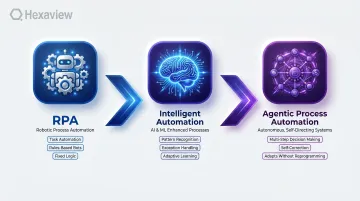
The industry broadly recognizes a three-stage evolution: RPA (task automation) → Intelligent Automation (AI/ML added) → Agentic Process Automation, where AI agents operate with enough autonomy to handle multi-step decisions, self-correct on exceptions, and adapt to new data patterns without reprogramming.
For buyers evaluating vendors: If a vendor can't explain how their system handles exceptions beyond "escalate to a human," you're looking at basic RPA — not intelligent automation.
Why Wealth Managers and Fund Admins Face Unique Automation Pressure
The Scale Problem
Wealth managers and fund admins juggle multi-custodian data feeds, complex fund structures (hedge funds, private equity, real estate), and hundreds of investor-specific reporting requirements. Operational staff dedicate 30% to 40% of their time to manual reconciliation and exception handling alone.
That overhead compounds fast. For a mid-sized fund manager with $500 million in AUM, manual operations typically require:
- 2-3 full-time employees solely for data entry and reconciliation
- 15-20 hours weekly on compliance documentation
- 8-10 hours per distribution cycle on calculation and verification
Regulatory Zero-Error Requirements
Those operational burdens don't exist in isolation — they run alongside a regulatory environment with no margin for error. SEC reporting (Form ADV, Form PF), AIFMD, and AML/KYC workflows are time-sensitive and zero-error-tolerant. The SEC's FY2024 enforcement actions resulted in $8.2 billion in financial remedies — the highest in agency history — with $600 million in penalties for off-channel communications failures alone.
Automation that creates defensible audit trails and consistent execution is, at this point, a risk management requirement.
The Talent Retention Crisis
Scale problems and compliance pressure collide with a third constraint: the people available to handle them. 34% of asset management executives cite talent risk as a top operational concern, while 50% of investment professionals would consider leaving the industry. Qualified candidates simply don't exist at the volume needed to absorb growing operational complexity.
Intelligent automation addresses what hiring cannot — freeing experienced staff from repetitive processing so they can focus on client relationships and higher-judgment work.
High-Impact Use Cases Across Wealth Management and Fund Administration
Wealth Management Use Cases
Automated Portfolio Rebalancing and Trade Order Management
For firms managing hundreds of model portfolios across thousands of accounts, a manual rebalancing cycle can stretch across multiple days. Intelligent automation monitors drift thresholds against model portfolios, generates rebalancing proposals, and routes orders for approval — compressing that cycle into same-day execution while reducing advisor time on manual calculation.
Client Reporting and Document Generation
Automated workflows pull holdings data, performance attribution, and benchmark comparisons from multiple systems, then generate personalized client reports (PDF or portal) on scheduled or event-triggered bases. Benefits include:
- Reduced report preparation time from days to hours
- Elimination of version control errors
- Consistent formatting and branding across all client communications
- Improved client experience through faster, more frequent updates
KYC/AML Onboarding Automation
Corporate client onboarding typically takes 90-120 days and approximately 51 hours of manual labor per client — a bottleneck that costs firms both time and prospective revenue. Intelligent automation extracts data from identity documents, cross-references sanctions lists and PEP databases, scores risk, and routes flagged cases to compliance officers, delivering an average 32% reduction in end-to-end onboarding time.
Fund Administration Use Cases
The efficiency gains don't stop at the client interface — fund administration operations are equally transformed by intelligent automation.
NAV Calculation Automation
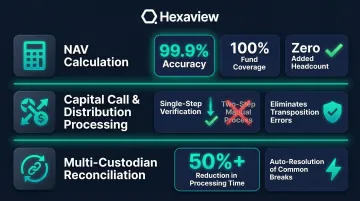
BNP Paribas deployed AI-powered NAV oversight across 15,000+ funds validated daily, achieving 99.9% accuracy in issue detection with zero additional headcount — and expanding coverage from roughly 5% sample-based validation to 100% of all daily NAVs. The underlying workflow ingests trade files, corporate actions, and pricing data from multiple sources, runs calculation workflows, and flags exceptions for human review.
Investor Capital Call and Distribution Processing
Automation generates notices, calculates allocations per LP agreement, triggers wire instructions, and updates investor ledgers. IQ-EQ reports that AI-driven document automation replaces a two-step manual process (entry by one analyst plus verification by a second) with single-step human verification of AI-populated data. This eliminates transposition errors across hundreds or thousands of notices simultaneously.
Multi-Custodian Reconciliation
ML-enhanced reconciliation bots match positions and cash across custodian feeds, auto-resolve common breaks, and escalate genuine exceptions. Firms transitioning from manual to automated operations typically see processing times decrease by 50% or more for routine tasks, reducing the daily reconciliation burden on ops teams.
The Business Case: Measurable Outcomes for Firms That Adopt IA
Efficiency Gains and Cost Reduction
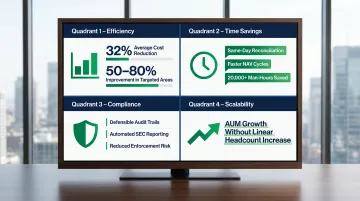
Organizations beyond the pilot stage have achieved an average cost reduction of 32%, up from 24% in 2020. Payback periods remain under 18 months for most implementations.
Hexaview's wealth management clients have saved over 20,000 man-hours in analysis and achieved a 97% improvement in data accuracy through automated reconciliation and reporting workflows.
Those efficiency gains extend directly to the cost structure. Key savings drivers include:
- Reduced overtime and contractor headcount
- Elimination of error-remediation costs
- Lower compliance failure risk
- Decreased reliance on manual quality assurance
Institutions that master automation implementation see 50% to 80% efficiency improvements in targeted areas like financial spreading and reconciliation.
Turnaround Time Improvement
Faster NAV cycles, same-day reconciliation, and real-time client reporting give firms a concrete edge in client retention and new business pitches. When relationship managers spend 60% to 70% of their time on non-revenue activities, reclaiming even a fraction of that capacity drives measurable revenue impact.
Risk and Compliance Benefits
Consistent, auditable automation creates defensible audit trails and generates compliance reports automatically. With SEC enforcement actions totaling $8.2 billion in FY2024 and off-channel communication penalties reaching $600 million across 70+ firms, the cost of compliance failures far exceeds the investment in proper automation.
Scalability Without Proportional Headcount Growth
IA enables firms to take on new fund structures, additional AUM, or expanded reporting requirements without linear staffing increases. BNP Paribas scaled NAV oversight to 15,000+ funds daily with zero additional headcount—demonstrating AUM growth without proportional operational expansion.
Implementation Pitfalls to Avoid
Automating Broken Processes
IA amplifies whatever exists in your workflow — including the problems. 95% of automation implementation barriers stem from organizational and strategic factors rather than technology itself, which means a poorly designed reconciliation process just becomes a faster one when automated.
Before automation build:
- Map current processes end-to-end
- Identify redundant steps and inefficiencies
- Redesign workflows for optimal automation
- Document exception-handling logic
Legacy System and Data Silo Fragmentation
Many firms run fragmented tech stacks—multiple OMS, PMS, custodian portals, and Excel-based shadow books. 46% of asset managers cite dependence on legacy systems as the biggest barrier to improving fund data and reporting.
IA implementation requires:
- Clear data governance frameworks
- Documented integration specifications
- API connectivity or middleware solutions
- Master data management discipline
Data fragmentation creates integration complexity — but once your systems are connected, the next risk shifts from access to accountability.
Under-Governed Automation in Regulated Environments
In regulated environments, bots need more than functional logic. Without defined exception-handling, audit trails, and human review checkpoints, automation introduces compliance exposure that auditors and regulators will surface quickly.
Required governance elements:
- Exception escalation protocols
- Audit trail documentation
- Version control for bot logic changes
- Regular validation against regulatory requirements
Governance keeps automation compliant — but scope creep is what kills the rollout before compliance even becomes a concern.
Boiling the Ocean
87% of financial institution leaders see IA as a priority, yet only 32% have moved beyond pilots to enterprise-wide implementation. That 55-point execution gap typically traces back to one mistake: attempting too much, too fast.
Recommended approach:
- Start with high-volume, low-exception processes (cash reconciliation, report distribution)
- Prove ROI within 3-6 months
- Scale to more complex workflows incrementally
- Build internal expertise through phased rollout

Choosing the Right IA Partner for Wealth Management and Fund Operations
Domain Expertise Requirements
Generic automation vendors rarely understand instrument types, fund structures, or investor reporting nuances. Look for partners with:
- Capital markets and fund operations experience — not just generic IT automation
- A track record with wealth managers, asset managers, or fund administrators — verify client references in your sector
- Demonstrated understanding of regulatory frameworks — SEC reporting, AIFMD, and AML/KYC compliance workflows
Security and Compliance Certifications
Financial data handling demands rigorous security standards:
- SOC 2 Type 2 certification — sustained operational discipline validated over 6-12 months
- ISO 27001 — comprehensive information security management controls
- Industry-specific compliance frameworks — GDPR, HIPAA (for health savings accounts), SOX
Integration Capability and Flexibility
Wealth tech stacks vary enormously. A capable partner connects IA solutions to your existing infrastructure — not around it:
- Existing PMS and OMS platforms
- Custodian APIs and SFTP feeds
- Reporting platforms and client portals
- CRM and document management systems — without requiring full-stack replacement
Hexaview's Position
With over 10 years working directly in capital markets and wealth management, Hexaview builds IA solutions that connect to custodian APIs, PMS platforms, and fund admin workflows out of the box — not as afterthoughts. That depth is reflected in how the market recognizes the firm:
- WealthTech 100 (2023) — acknowledging innovation in wealth management technology
- SOC 2 Type 2 certification — demonstrating sustained security and operational discipline
- Deloitte Technology Fast 50 (India) — validating rapid growth and market traction
- Serving clients including LPL Financial and Addepar — with proven delivery in wealth management environments
Hexaview's multi-custodian data integration work demonstrates the ability to consolidate disconnected data sources (LPL, Fidelity, Schwab, ORION, eMoney) into unified, automated pipelines—addressing the exact fragmentation challenges wealth managers and fund admins face daily.
Frequently Asked Questions
What is intelligent process automation in financial services?
Intelligent process automation (IPA) combines RPA, AI, and machine learning to automate both rules-based and judgment-intensive financial workflows. Unlike basic automation, IPA handles exceptions, learns from data patterns, and adapts over time, making it suitable for complex tasks like risk scoring, fraud detection, and compliance monitoring.
How is RPA used in financial services?
RPA automates high-volume, repetitive tasks including data entry and reconciliation, transaction processing, report generation, customer onboarding, and compliance document handling. 74% of financial services firms are currently implementing RPA, with organizations expecting an average 31% cost reduction over the next three years.
Is RPA still relevant in financial services?
Yes—RPA remains the foundational layer of automation in financial services. Most firms now layer AI and ML on top of RPA to handle more complex, exception-heavy workflows. This combination — intelligent automation — is the natural evolution, with the market projected to grow from $685.7 million in 2022 to $8.79 billion by 2030.
What is the future of intelligent automation in financial services?
The near-term roadmap includes agentic AI for autonomous portfolio decisions, real-time compliance monitoring, and end-to-end straight-through processing (STP). 92% of implementers are already pursuing or planning full end-to-end automation, with AI Copilots set to reshape how relationship managers work.
What are the top RPA software tools for financial services?
Commonly used platforms include UiPath, Automation Anywhere, Blue Prism, and Microsoft Power Automate — Automation Anywhere earned its seventh consecutive Leader ranking in the 2025 Gartner Magic Quadrant for RPA. The right choice depends on your custodian APIs, PMS/OMS compatibility, and compliance requirements.